
Word Unscramble Cheats: A Smart Guide to Solvers
The Puzzle in Your Pocket
You’re three rounds into a Scrabble game, sitting on a rack full of awkward consonants — two K’s, a Q, no U — and you’ve been staring at the same letters for four minutes. Someone else just played QUARTZ on a triple word score, and the panic is real. You open your phone. Type in the letters. A list appears.
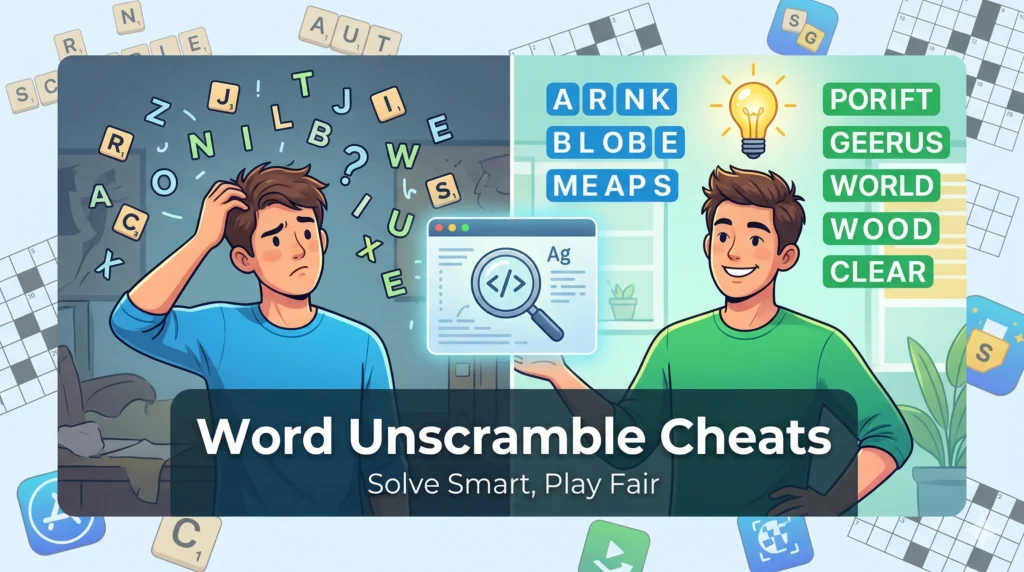
That moment — the split-second decision between looking it up and figuring it out yourself — is where the whole conversation about word unscramblers begins.
These tools are everywhere, and they’re genuinely useful. But understanding how they work, when to reach for one, and how not to let them quietly drain the joy out of your game is worth thinking about before you type in that next rack of tiles.
What a Word Unscrambler Actually Does
A word unscrambler is a digital tool that accepts a string of jumbled letters as input and returns every valid word that can be made from those letters. You type in your tiles — say, LBAET — and within milliseconds the tool returns TABLE, BLEAT, BLATE, and a handful of shorter options sorted by length or point value.
The core task is deceptively simple: take a set of characters, find every valid arrangement (or subset), and match those arrangements against a dictionary of real words. Most modern tools also let you filter results by word length, by starting or ending letters, or by a specific dictionary — such as the official Scrabble TWL word list, the international SOWPODS list, or the Words With Friends dictionary.
What makes word unscramblers useful beyond just “cheating” is their role as a learning scaffold. For new players, seeing the full solution space for a given letter rack teaches vocabulary patterns they’d never encounter otherwise. For experienced players, a solver can verify a word they already suspect exists but aren’t certain of.
How Solvers Work Behind the Scenes
The technical process is more elegant than it might seem. Two main algorithmic approaches power most anagram solvers today, and understanding them reveals why these tools are so fast.
The Sorted-Key Method
The most widely used technique is called the sorted-key (or canonical signature) approach. Here’s how it works:
- Every word in a dictionary is preprocessed: its letters are sorted alphabetically, creating a unique “signature.” The word TABLE becomes ABELT; BLEAT also becomes ABELT.
- This means that every anagram of a word shares the same sorted signature.
- When you input scrambled letters, the tool sorts your letters the same way and looks up that signature in its hash table — a data structure that enables near-instant lookup regardless of dictionary size.
- All words whose signatures match are returned as valid results.
This approach is enormously faster than brute force. A naive approach — trying every possible permutation and checking each one against the dictionary — runs at factorial complexity: 7 letters produce 5,040 permutations to test. The sorted-key method collapses that entire process into a single lookup operation.
The Trie (Prefix Tree) Method
More sophisticated solvers use a data structure called a trie — a tree where each node represents a letter, and paths from root to leaf spell out valid words. The trie approach is especially powerful for partial matches and filtering:
- You can efficiently prune dead-end paths early, skipping letter combinations that can’t possibly form valid words.
- It handles wildcard or blank tiles gracefully, testing multiple branches simultaneously.
- It supports prefix-based searching, enabling “starts with” or “ends with” constraints.
Both methods draw on pre-validated word lists. The best tools use officially licensed dictionaries containing 170,000+ entries, verified against the word lists used by competitive Scrabble or Words With Friends organizations. The result: what looks like a magic trick on your screen is, under the hood, a well-engineered lookup system running in milliseconds.
Why People Reach for Them
The motivations are varied — and most of them are perfectly reasonable.
Beginners learning the ropes. When you’re new to Scrabble or Wordscapes, you don’t yet know that QI, ZAX, or AEON are valid plays. A word unscrambler introduces these words in context, making them memorable in a way a vocabulary list never could. Seeing QOPH come back as a valid seven-letter word teaches you something that sticks.
Players who are genuinely stuck. Even experienced players hit walls. A difficult letter combination, an unusual vowel-consonant ratio, or simple mental fatigue can make a solvable rack feel impossible. Using a solver in that moment is less about cheating and more about not abandoning the game entirely.
Curiosity about what’s possible. After a game, many players use unscramblers retrospectively — not to play words, but to understand what they could have played. This post-game analysis is one of the most effective ways to improve.
Educators and developers. Crossword constructors, vocabulary app builders, and ESL teachers use these tools professionally to generate word lists, test letter distributions, and design puzzles.
Where the Cheat Line Gets Blurry
This is where things get genuinely interesting — and honest conversation is warranted.
Context Is Everything
In a solo puzzle game like Wordle or a letter-jumble app you downloaded for brain training, using a solver against yourself defeats the purpose. The entire value of the exercise is the cognitive struggle: the moment your brain suddenly clicks on a pattern, the satisfaction of placing a rare word, the neural reward that accompanies genuine problem-solving. Skip that process and you skip the benefit entirely.
In competitive multiplayer word games — Scrabble club tournaments, rated Words With Friends matches, head-to-head leagues — using an external solver mid-game is widely considered cheating. Serious players can often identify a cheating opponent: they consistently play high-difficulty words from awkward letter combinations, show no strategic sense for the board, and never make the defensive plays a skilled human would. The vocabulary is there; the game intelligence isn’t.
The Mutual Agreement Loophole
In casual, informal play between friends or family, the line is whatever you agree it is. Some households treat looking up words as perfectly fine — analogous to checking a physical dictionary, which has always been acceptable in casual Scrabble. Others consider any external tool unsporting. Neither position is wrong; what matters is that everyone at the table agrees on the rules before the game starts.
The real problem arises when one player quietly uses a solver while others assume they’re playing fair. That’s not a gray area — it’s deception.
The Skill Hollowing Effect
There’s a subtler issue beyond fairness. Word games build vocabulary, sharpen pattern recognition, and improve language fluency precisely because they are difficult. Regular puzzle play stimulates neuroplasticity — the brain’s ability to adapt and form new pathways. Researchers note that word games strengthen both short- and long-term memory recall, increase focus, and can slow cognitive decline over time.
When a solver becomes a reflex — when you type in letters before even attempting to find a word yourself — the skill-building mechanism breaks. You get the points; your brain gets nothing.
How to Keep the Fun Intact
The best way to use a word unscrambler is as a last resort, not a first response. Here’s a practical framework:
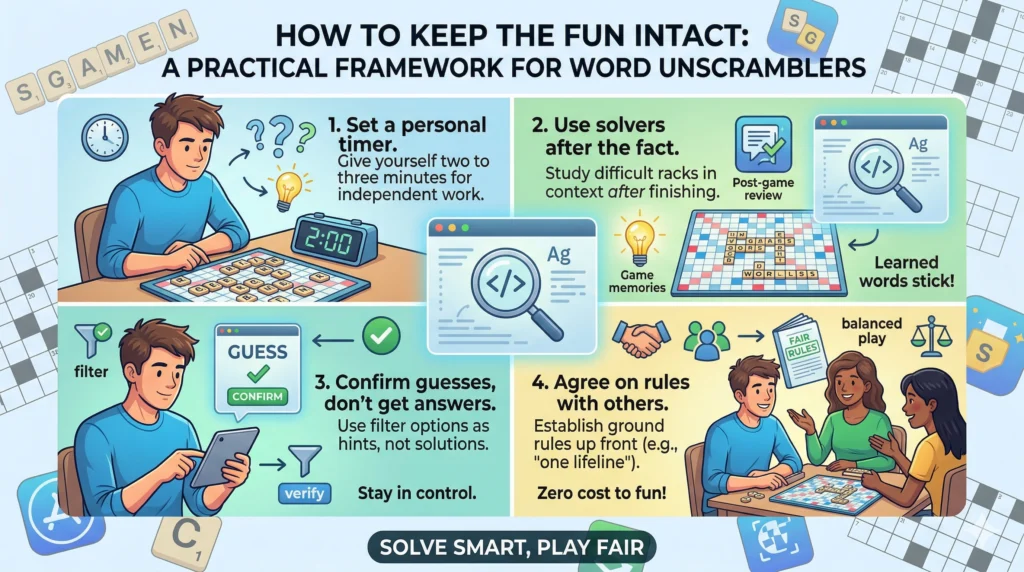
Set a personal timer. Give yourself two to three minutes to work with the letters independently before reaching for any tool. This creates space for real problem-solving without turning the game into an ordeal.
Use solvers after the fact. Post-game review is where solvers deliver maximum value with zero cost to fun. After you finish, input your most difficult rack and study what you missed. Words learned this way — in context, attached to a specific game memory — tend to stick.
Use the filter options as hints, not answers. Instead of asking the solver to give you all valid words, use it to confirm whether a specific word you’re guessing at is actually valid. This keeps you in the driver’s seat.
Agree on tool rules up front. If you’re playing with others, establish the ground rules before the first tile is drawn. Some friend groups allow one solver consultation per game as a “lifeline” — keeping things fun without handing anyone an unfair advantage.
Smarter Alternatives to Full Cheating
Before you open a solver, try these proven techniques that build real game intelligence over time:
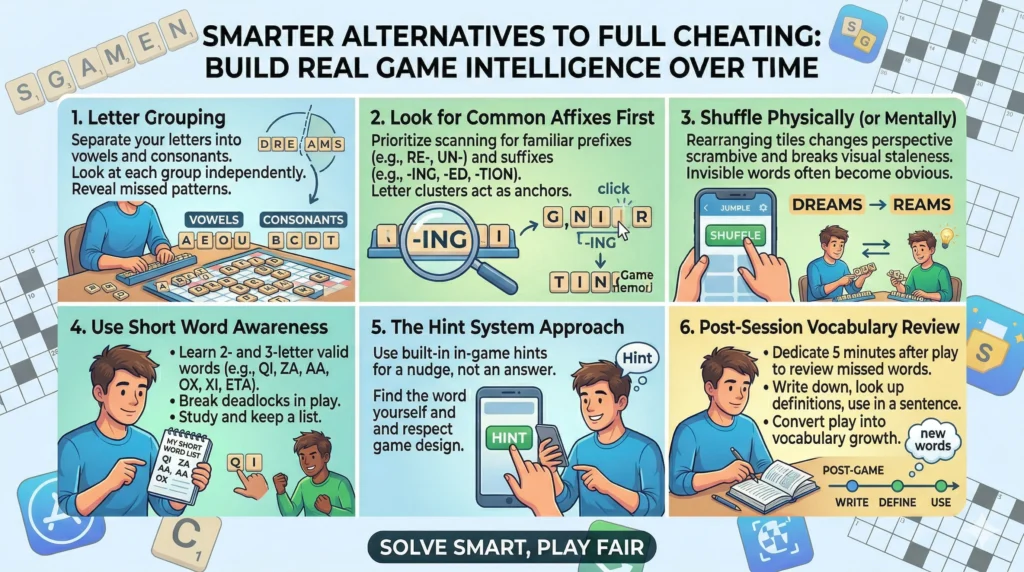
1. Letter Grouping
Separate your letters into vowels and consonants. Look at each group independently before trying to combine them. Most English words follow predictable vowel-to-consonant ratios — this simple act of grouping can reveal patterns your brain missed when looking at the full jumble.
2. Look for Common Affixes First
Before scanning for full words, scan for familiar endings (-ING, -ED, -TION, -LY, -ER, -EST) and beginnings (RE-, UN-, PRE-, DE-, DIS-). These letter clusters act as anchors around which the rest of the word often clicks into place. A rack containing G, N, I, R, and three other letters almost always contains a word ending in -ING.
3. Shuffle Physically (or Mentally)
Rearranging tiles into a new order forces your visual system to re-perceive the same information differently. Online games typically have a shuffle button for exactly this reason. The word that was invisible in one order frequently becomes obvious in another.
4. Use Short Word Awareness
Knowing your two- and three-letter valid words is one of the highest-leverage skills in competitive word games. Words like QI, ZA, AA, OX, XI, and ETA aren’t common knowledge — but learning them lets you break deadlocks without needing a solver at all. Keep a running list and study them intentionally.
5. The Hint System Approach
Many word game apps include a built-in hint system. These hints exist for a reason — they’re designed to give you just enough nudge to find the word yourself, rather than handing over the answer outright. Using an in-game hint respects the game’s design intent in a way that an external full solver often doesn’t.
6. Post-Session Vocabulary Review
Dedicate five minutes after each game to reviewing words you didn’t know. Write them down, look up their definitions, and use them in a sentence. This converts a game into genuine vocabulary growth — and the next time those letters come up, you won’t need a solver at all.
The Practical Takeaway
Word unscramblers are not inherently bad tools. They’re algorithmically elegant, they can serve real educational purposes, and for beginners they provide a window into a vocabulary they haven’t yet built. The problem is never the tool — it’s the habit.
If a solver is replacing effort rather than supplementing it, the trade-off isn’t worth it. The challenge is where the value lives. A solved puzzle that you hand to a computer is a missed opportunity for the kind of thinking that makes the next puzzle easier, the next game more satisfying, and your command of language genuinely sharper.
Use the tool when you’re truly stuck. Study what it shows you. Put it down and play the next rack yourself. That rhythm — attempting, failing, learning, improving — is the whole point of the game.