
Smart, Affordable Recycled Asphalt Driveway Guide
The modern homeowner faces a complex and highly consequential decision when paving a residential property. Balancing upfront costs, long-term maintenance requirements, and environmental impact necessitates a thorough understanding of the available paving materials. A recycled asphalt driveway represents one of the most practical and efficient solutions in civil engineering today, bridging the gap between inexpensive, high-maintenance loose gravel and premium, high-cost virgin hot-mix pavements.
This comprehensive report explores exactly what a recycled asphalt (or bitumen) driveway entails, detailing the precise material science behind its performance. The analysis outlines regional terminology across global markets, realistic cost breakdowns, granular step-by-step installation methodologies, and exact maintenance requirements. Property owners will learn how to estimate project expenses using a driveway cost calculator, ensuring a fully informed decision when comparing sustainable driveway materials. The objective is to provide a detailed, engineering-grade understanding of reclaimed pavement, equipping readers with the knowledge to manage contractors, evaluate quotes, and maintain a durable surface for decades.
What Is a Recycled Asphalt (Bitumen) Driveway?
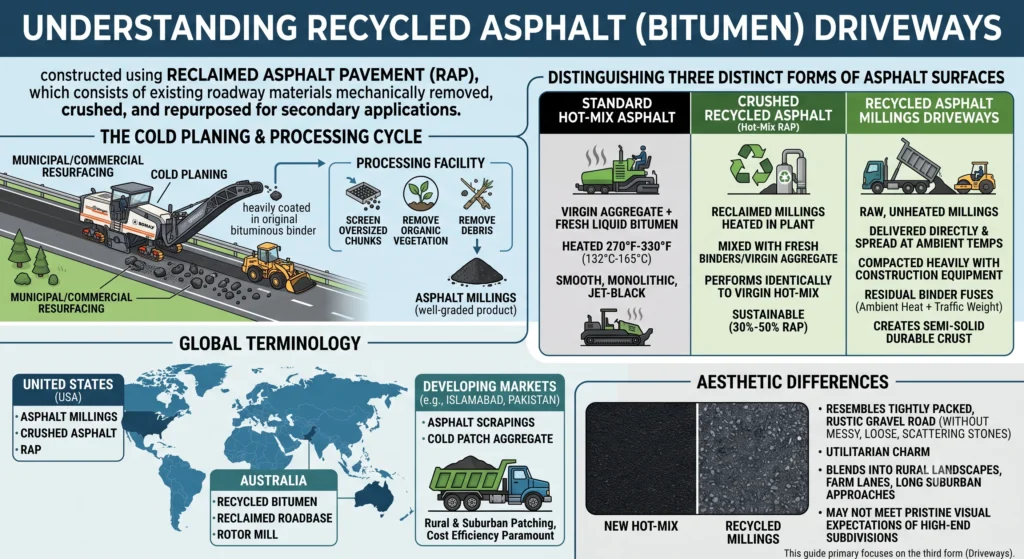
To make an informed choice regarding property infrastructure, it is imperative to understand the origin, composition, and physical properties of reclaimed materials. A recycled asphalt driveway is constructed using Reclaimed Asphalt Pavement (RAP), which consists of existing roadway materials that have been mechanically removed, crushed, and repurposed for secondary applications.
When municipalities, transportation departments, or commercial entities resurface highways and parking lots, heavy milling machines—such as those manufactured by industry leaders like Wirtgen, Sany, or Bomag—grind up the top layer of the aged pavement. This process, known as cold planing, generates small, aggregate-like chunks of stone that remain heavily coated in the original bituminous binder. Following extraction, this material is typically transported to a processing facility where it is screened to remove oversized chunks, organic vegetation, and debris, resulting in a consistent, well-graded product known as asphalt millings.
It is crucial to distinguish between three distinct forms of asphalt surfaces available to consumers, as the terminology can often lead to procurement errors:
- Standard Hot-Mix Asphalt: This represents the traditional paving method, utilizing virgin aggregate mixed with fresh, liquid bitumen heated to temperatures between 270°F and 330°F (132°C to 165°C). It creates the smooth, monolithic, jet-black surface commonly seen on new highways and premium suburban driveways.
- Crushed Recycled Asphalt (Hot-Mix RAP): This process involves transporting reclaimed millings back to an asphalt batch plant, where they are heated and mixed with fresh binders and virgin aggregate. It performs identically to virgin hot-mix but utilizes sustainable recycled content, often incorporating 30% to 50% RAP into the new mix.
- Recycled Asphalt Millings Driveways: This is the primary subject of this guide. The raw, unheated millings are delivered directly to the residential site, spread at ambient temperatures, and compacted heavily with construction equipment. Over time, ambient heat from the sun and the compressive weight of vehicle traffic cause the residual binder in the millings to fuse, creating a semi-solid crust that is highly durable.
Terminology varies significantly across global regions, reflecting local construction cultures. In the United States, contractors refer to this material predominantly as “asphalt millings,” “crushed asphalt,” or “RAP”. In Australia, the standard terminology favors “recycled bitumen,” “reclaimed roadbase,” or “rotor mill”. In developing infrastructure markets such as Islamabad, Pakistan, the material is frequently referred to as “asphalt scrapings” or “cold patch aggregate,” and is often transported by local dumper trucks for rural and suburban patching projects where cost efficiency is paramount.
Aesthetically, property owners researching pictures of recycled asphalt driveways will notice a distinct visual difference compared to new hot-mix pavements. A recycled asphalt surface does not present as a deep, uniform black monolith. Instead, it features a textured, charcoal-grey or slate appearance with visible speckles of the underlying aggregate. As it compacts over the first few months of use, it closely resembles a very tightly packed, rustic gravel road, but notably lacks the messy, loose, scattering stones associated with standard gravel installations. The surface carries a utilitarian charm that blends seamlessly into rural landscapes, farm lanes, and long suburban approaches, though it may not meet the pristine visual expectations of high-end, heavily regulated subdivisions.
Is a Recycled Asphalt Driveway a Good Idea?
When evaluating infrastructure upgrades, property owners frequently ask, “does recycled asphalt make a good driveway?” or search for confirmation on whether “is recycled asphalt good for a driveway.” The answer is highly dependent on the specific use case, budget constraints, and aesthetic expectations of the property in question. For rural estates, long agricultural lanes, extensive suburban approaches, and budget-conscious homeowners, it is an exceptionally pragmatic and intelligent choice. However, for those expecting the flawless, uniform blacktop of a newly built suburban subdivision, it may fall short of visual expectations.
To evaluate performance, one must examine how the material behaves under physical stress and environmental weathering. Unlike loose gravel, which displaces, scatters, and ruts under heavy vehicle tires, the residual bitumen on recycled asphalt provides a unique “self-cementing” property. When compressed by a heavy vibratory roller during installation, and subsequently subjected to intense summer heat, these bitumen-coated stones stick together. This continuous rebinding creates a surface that offers excellent traction, minimal dust compared to crushed limestone, and a comfortable, relatively quiet driving experience.
A comprehensive pros and cons section is necessary to objectively weigh the material’s viability.
The advantages of utilizing reclaimed asphalt are substantial. The most prominent benefit is the dramatically lower upfront cost, as reusing milled materials eliminates the high expenses associated with refining crude oil for virgin bitumen and mining fresh aggregate. From an environmental perspective, the reuse of materials prevents millions of tons of construction debris from occupying landfills and drastically reduces the carbon footprint associated with manufacturing and heating new paving materials. Furthermore, recycled asphalt millings are not a completely sealed, impermeable monolith. The surface retains a degree of porosity, which provides excellent drainage. This allows rainwater to percolate through the surface rather than pooling or creating dangerous runoff, assuming the sub-base is properly graded. Additionally, repairs are notably easier. Unlike solid concrete, which requires jackhammers and expensive full-depth replacement when it cracks, or monolithic hot-mix asphalt that requires saw-cutting, a damaged section of a millings driveway can simply be scarified (loosened), leveled, and re-compacted with a hand tamper.
Conversely, the disadvantages must be carefully considered. The aesthetic is less “perfect” than new asphalt, presenting a coarse, uneven texture that resembles a hybrid between pavement and gravel. During the initial curing phase, there is a potential for dust or loose granular fines to stick to vehicle tires and shoes, which can track dirt into garages or homes until the surface fully hardens. The material is also highly sensitive to poor base preparation; if the sub-grade beneath the recycled asphalt is soft, muddy, or poorly drained, the millings will sink and form deep ruts under vehicle weight. Finally, property owners may face possible HOA or municipal regulation issues. Some strict Homeowner Associations or local zoning codes mandate solid paved surfaces and may erroneously classify millings as an unapproved “loose” material, requiring homeowners to seek variances or risk fines.
Understanding recycled asphalt driveway problems is critical to avoiding premature failure. The most common issues—cracks, potholes, and rutting—stem from subpar installation practices rather than inherent flaws in the material itself. If a contractor fails to properly compact the millings with a heavy vibratory roller, the surface will remain loose, susceptible to washout during heavy rains, and prone to edge deterioration. Similarly, if the driveway is not graded with a slight crown or cross-slope to manage hydrostatic pressure, water will pool on the surface. Standing water acts as a solvent over time, breaking down the residual bitumen binder and leading to rapid deterioration and pothole formation.
Recycled Asphalt Driveway Cost: How Much Does It Really Cost?
Estimating a recycled asphalt driveway cost requires breaking the civil engineering project down into precise, transparent components. The total financial outlay is rarely just the cost of the raw material; rather, it is a complex combination of material procurement, heavy equipment transportation, extensive base preparation, compaction equipment rental, and specialized labor.
Understanding the recycled asphalt driveway price involves looking at the density and volumetric requirements of the material. Asphalt millings are exceptionally heavy, typically weighing around 140 to 145 pounds per cubic foot when compacted. Therefore, pricing in the industry is generally calculated per ton (or tonne) for the raw material at the processing plant, and per square foot (or square meter) for the fully installed project presented to the consumer.
The cost components break down as follows. Material price represents the smallest fraction of the budget. In the United States, raw recycled asphalt millings typically cost between $10 and $30 per ton at the processing yard, compared to $80 to $120 per ton for virgin hot-mix. Transport costs are highly variable; dump trucks are required to haul the heavy material, and delivery fees depend heavily on the distance from the asphalt plant to the residential site, often adding $100 to $200 per truckload. Base preparation is often the most expensive component. If the existing driveway needs to be excavated to remove organic topsoil, or if a new crushed stone sub-base must be laid to ensure stability, machinery like skid steers, motor graders, and dump trucks must be deployed. Finally, labor and compaction equipment factor heavily into the final cost of recycled asphalt driveway installations. A crew of three to five workers, utilizing a 3-ton to 5-ton vibratory steam roller, is necessary to spread, grade, and compact the material properly to achieve the required density.
When looking at the recycled asphalt driveway cost per square foot, regional differences become apparent.
| Region | Fully Installed Cost Range | Raw Material Cost Range | Primary Cost Drivers |
| United States | $3.00 – $8.00 per sq. ft. | $10 – $30 per ton | Excavation depth, hauling distance, local labor rates. |
| Australia | $35 – $90 AUD per sq. m. | $50 – $100 AUD per tonne | Council kerb permits, drainage requirements, regional material scarcity. |
| Pakistan | Highly variable based on transport | Negotiated per dumper truck | Fuel costs for transport, availability of heavy rollers. |
To illuminate how these variables interact in the real world, examining worked examples allows property owners to see the math behind contractor quotes.
Consider a small driveway cost estimate in a typical United States suburb. A property requires a driveway measuring 10 feet wide by 40 feet long (400 square feet). The existing gravel base is solid, meaning no deep excavation is required, and the property owner desires a standard 3-inch compacted depth of millings. First, the volume is calculated: 400 square feet multiplied by 0.25 feet (3 inches) equals 100 cubic feet. Applying the density of 140 pounds per cubic foot yields 14,000 pounds, or exactly 7 tons of material. At a material rate of $20 per ton, the raw millings cost just $140. However, the contractor must charge a $150 flat delivery fee, plus $800 for a half-day of labor involving a skid steer operator, a roller operator, and a laborer to manage the edges. The total estimated cost reaches $1,090, which translates to roughly $2.72 per square foot. This represents a best-case scenario where site conditions are ideal.
Conversely, consider a medium driveway cost estimate in an Australian context. A homeowner in a regional area requires a 60-square-meter driveway. The site suffers from poor drainage and requires minor grading to establish a 1:100 fall, along with a new layer of rotor mill. The industry average rate for a complete service—including material, delivery, leveling, and heavy vibratory rolling—is approximately $50 AUD per square meter. The total estimated cost amounts to $3,000 AUD.
Factors that drive the price up exponentially include extensive tree root removal, unstable clay soils requiring the installation of French drains or geo-grid reinforcement, and long transportation distances from the recycling plant, all of which inflate labor hours and equipment rental durations.
Recycled Asphalt Driveway Cost vs Gravel
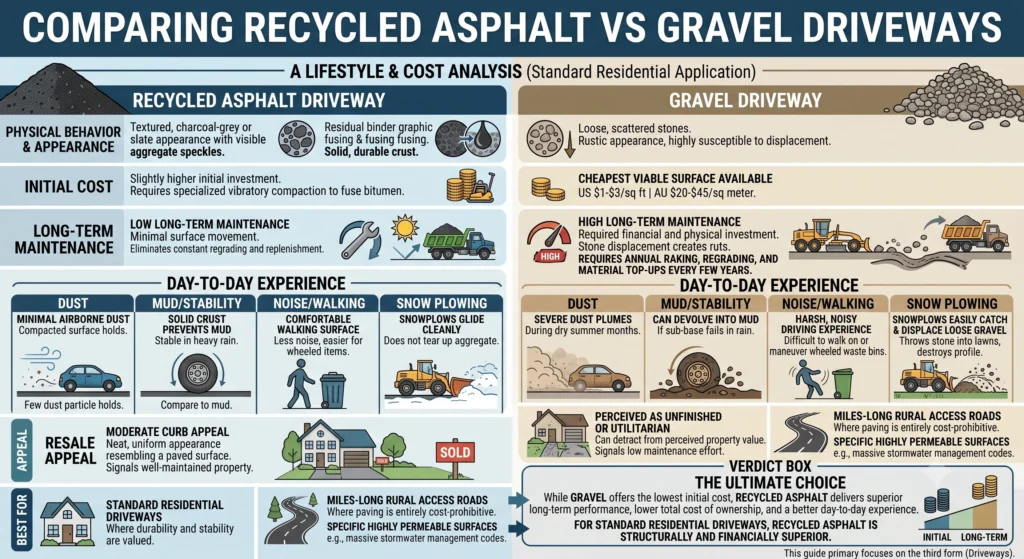
When homeowners seek budget-friendly infrastructure options, the primary debate within civil construction usually centers on the recycled asphalt driveway cost vs gravel. While both are aggregate-based materials utilized extensively in rural and suburban settings, their physical behavior under load, binding mechanisms, and long-term financial implications are vastly different.
Analyzing the cost of recycled asphalt vs gravel driveway installations heavily favors gravel regarding the initial, upfront invoice. A basic gravel driveway generally costs between $1 and $3 per square foot in the US, or $20 to $45 per square meter in Australia, making it the cheapest viable surface available. As established, recycled asphalt runs slightly higher upfront due to the specialized vibratory compaction required to fuse the bitumen. However, evaluating the total cost of ownership over a ten-year lifecycle reveals a starkly different financial reality.
The long-term maintenance of gravel demands continuous financial and physical investment. Because gravel relies purely on gravity and the jagged edges of the stone to remain in place, it is highly susceptible to displacement. Vehicle tires push the stones outward, creating deep ruts, while heavy rainfalls easily wash the loose aggregate down slopes. This necessitates annual raking, regrading with a tractor or grader blade, and purchasing costly top-up loads of fresh stone every few years to replace lost material. In contrast, the residual bitumen in recycled asphalt acts as a powerful binding agent. Once compacted and exposed to solar heat, the material forms a semi-solid crust that drastically reduces surface movement, eliminating the need for constant regrading and material replenishment.
The day-to-day experience of living with the materials also differs significantly. Gravel generates severe dust plumes during dry, arid summer months and can devolve into a muddy, unstable surface during prolonged rain events if the sub-base fails. The loose stones also create a harsh, noisy driving experience and are notoriously difficult to walk on or maneuver wheeled waste bins over. Furthermore, in climates that experience heavy snowfall, snowplows easily catch and displace loose gravel, throwing it into adjacent lawns and destroying the driveway profile. Recycled asphalt mitigates all of these issues. The solid crust prevents mud formation, minimizes airborne dust, offers a comfortable walking surface, and allows snowplows to glide cleanly over the driveway without tearing up the aggregate.
Regarding resale appeal, gravel is often viewed by prospective homebuyers as an “unfinished” or purely utilitarian feature, which can detract from the perceived value of a residential property. Recycled asphalt, while not as refined as premium hot-mix, presents a neat, uniform appearance that resembles a fully paved surface, adding a moderate level of curb appeal and signaling to buyers that the property is well-maintained.
Ultimately, gravel remains the smarter choice only in highly specific scenarios: for miles-long rural access roads where paving of any kind is entirely cost-prohibitive, or in municipalities where strict environmental codes demand 100% highly permeable surfaces for massive stormwater management. For standard residential driveways, recycled asphalt is the structurally and financially superior choice, bridging the gap between low initial cost and long-term stability.
How to Install a Recycled Asphalt Driveway (Step‑By‑Step)
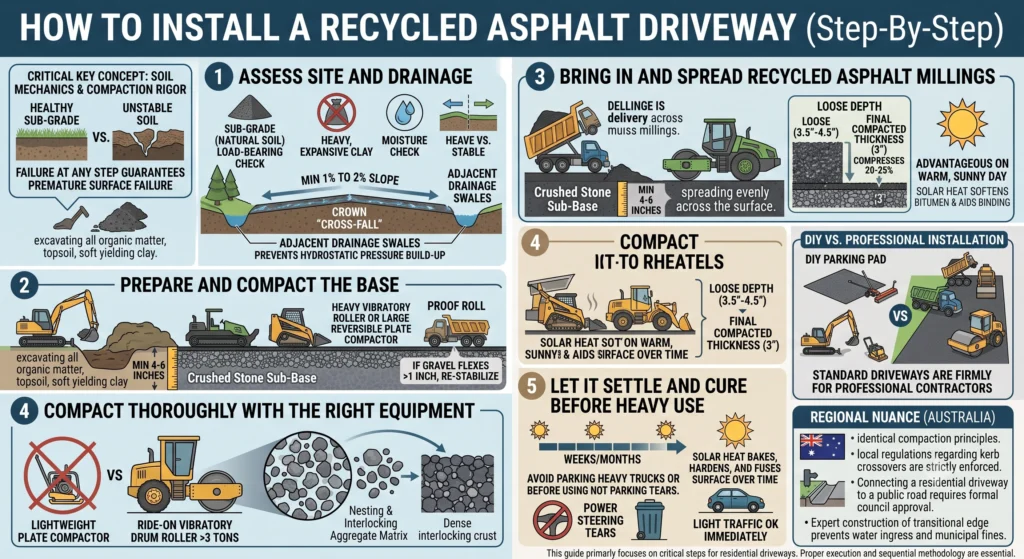
Understanding how to install recycled asphalt driveway materials is vital, whether a property owner intends to hire a professional contractor or attempt a highly ambitious DIY recycled asphalt driveway. While paving driveway with recycled asphalt correctly may seem straightforward, the civil engineering principles governing soil mechanics and compaction must be rigorously adhered to. A failure at any step in the process guarantees premature surface failure.
The installation process follows a strict, sequential methodology:
Step 1: Assess Site and Drainage The longevity of any pavement is entirely dependent on its foundation and its ability to shed water. The sub-grade (the natural soil) must be assessed for load-bearing capacity. If the soil consists of heavy, expansive clay, it will retain moisture, become highly unstable, and heave during winter freezes. The driveway layout must be engineered with a minimum 1% to 2% slope (a crown down the center or a cross-fall to one side) to ensure hydrostatic pressure does not build up and that surface water sheds efficiently into adjacent drainage swales.
Step 2: Prepare and Compact the Base The site must be excavated to remove all organic matter, topsoil, and soft yielding clay, which decompose and shift over time. For standard residential driveways supporting passenger vehicles, a minimum of 4 to 6 inches of a crushed stone sub-base—such as dense-graded aggregate, roadbase, or crushed concrete—must be installed. This foundational layer must be compacted utilizing a heavy vibratory roller or a large reversible plate compactor until it is completely unyielding. A “proof roll” is often conducted by driving a heavy dump truck over the base; if the gravel flexes or ruts more than an inch, the base requires further stabilization.
Step 3: Bring in and Spread Recycled Asphalt Millings Once the sub-base is verified as solid, the asphalt millings are delivered via dump trucks. The material must be spread evenly across the surface using a skid steer loader, a motor grader, or a specialized paving box. To achieve a final compacted thickness of 3 inches, the millings should be spread to a loose depth of roughly 3.5 to 4.5 inches. Because the milled material contains significant air voids, it will compress downward by approximately 20% to 25% during the rolling process. Spreading the material on a warm, sunny day is highly advantageous, as the ambient heat naturally softens the residual bitumen, significantly aiding in the mechanical binding process.
Step 4: Compact Thoroughly with the Right Equipment Compaction is the transformative step that turns a bed of loose stone into a solid, functional driveway. A simple hand tamper or a lightweight walk-behind plate compactor is fundamentally insufficient for the main driving surface, as they lack the deep vibratory amplitude required to lock the aggregate matrix together. A ride-on vibratory drum roller (weighing at least 3 tons) must be driven over the surface in overlapping passes. The intense vibration forces the aggregate particles to nest tightly together, while the static weight presses the bitumen binder into a dense, interlocking crust.
Step 5: Let it Settle and Cure Before Heavy Use After the final compaction pass, the driveway enters a critical curing phase. While the surface can typically handle light passenger vehicle traffic almost immediately, it is civil engineering best practice to avoid parking heavy trucks or turning wheels sharply in place (power steering tears) for the first few days. Over the subsequent weeks and months, the heat of the sun will continue to bake the surface, further hardening and fusing the recycled asphalt into a highly cohesive, durable layer.
The distinction between a DIY project and professional installation is stark. While a motivated homeowner can manage the spreading of millings for a small parking pad, the requirement for heavy excavation machinery and a multi-ton vibratory roller places standard driveway installations firmly in the domain of professional contractors. Furthermore, regional nuances apply. For property owners researching how to do a recycled bitumen driveway Australia, the core principles of compaction remain identical, but local regulations regarding kerb crossovers are strictly enforced. Connecting a residential driveway to a public road requires formal council approval, and the transitional edge between the recycled bitumen and the concrete street gutter must be expertly constructed to prevent water ingress and municipal fines.
Recycled Asphalt Driveway Maintenance and Sealing
A primary motivation for selecting this material is the relatively low maintenance requirement, provided the initial installation was executed according to civil engineering standards. However, recycled asphalt driveway maintenance is occasionally necessary to preserve the structural integrity and aesthetic of the surface over its 15 to 20-year lifespan.
Simple maintenance routines involve proactive visual inspections of the driveway following heavy seasonal rains or severe winter thaws. If minor rutting occurs where vehicle tires consistently track, or if the edges begin to fray outward, the material can be easily remediated. The property owner simply needs to add a small volume of fresh millings to the depression, lightly hydrate it to aid compaction, and compress it heavily with a steel hand tamper or plate compactor. Managing drainage is equally critical; keeping adjacent grass edges trimmed lower than the driveway surface ensures that water does not dam up and pool on the asphalt, which would otherwise degrade the binder.
The topic of recycled asphalt driveway sealing is frequently debated within the paving industry, leading many homeowners to ask, “can you seal a recycled asphalt driveway?” The answer is yes, but utilizing standard driveway paint or inexpensive acrylic coal-tar sealers sold at hardware stores is a critical error.
Because recycled asphalt is highly porous and the original binder has been subjected to years of environmental oxidation (a process that destroys the flexible, volatile oils known as maltenes in the bitumen, leaving behind brittle asphaltenes), standard surface sealers simply peel and flake off. Instead, property owners must utilize a specialized recycled asphalt driveway sealer known technically as an asphalt rejuvenator or a bio-based emulsion.
Asphalt rejuvenators are deeply penetrating oils—often derived from agricultural bio-oils or engineered petroleum emulsions—designed specifically to soak directly into the porous matrix of the millings. They chemically interact with the old, stiff bitumen, restoring its flexibility, viscosity, and binding power at a molecular level.
When does it make sense to apply these products? Applying a rejuvenator 6 to 12 months after the driveway has been installed allows the millings to undergo primary compaction via traffic and solar heat. Spraying a rejuvenator at an engineered rate of 10 to 15 square feet per gallon forces the aggregate to lock together permanently and transforms the faded, grey millings into a rich, dark black surface that closely resembles new pavement. Realistic expectations must be maintained; rejuvenators will dramatically improve cohesion, lock down loose fines, and enhance the appearance, but they will not magically transform a textured millings driveway into a perfectly smooth, monolithic hot-mix surface. Reapplication of the emulsion may be necessary every 3 to 5 years, highly dependent on daily traffic volumes and regional climate exposure.
Using a Driveway Cost Calculator for Recycled Asphalt
To avoid ordering excess material, suffering from mid-project shortages, or falling victim to inflated contractor quotes, property owners should utilize a driveway paving cost calculator. Understanding the underlying mathematics behind a recycled asphalt driveway calculator ensures absolute transparency and accuracy in the procurement process.
An asphalt driveway cost calculator requires three primary geometric inputs from the user: the area in square feet (derived from the length and width of the driveway) and the desired compacted thickness of the material.
The industry-standard civil engineering formula used by estimators dictates that tonnage equals the volume of the space multiplied by the density of the material, divided by 2,000 pounds to convert the mass into short tons. As previously established, standard compacted asphalt millings possess a density of roughly 140 to 145 pounds per cubic foot.
Consider an example of how a homeowner could plug in their driveway size to interpret the outputs and generate a realistic range. If a property owner requires a driveway that is 60 feet long, 12 feet wide, and demands a robust 4 inches of compacted thickness to support heavy pickup trucks:
- The calculator first converts the 4 inches of depth into a decimal measurement in feet (4 ÷ 12 = 0.333 feet).
- It then calculates the total volume of the excavation: 60 ft (length) × 12 ft (width) = 720 square feet (Area) × 0.333 ft (depth) = 240 cubic feet.
- It applies the specific material density: 240 cubic feet × 140 lbs/cu ft = 33,600 lbs of total mass.
- Finally, it converts the mass to tons: 33,600 lbs ÷ 2,000 = 16.8 tons.
A highly accurate calculator will automatically incorporate a 5% to 10% “waste factor.” This contingency accounts for irregular, flared edges, spillage during dumping, and minor variations in the sub-grade elevation that require extra material to level. Therefore, the calculator would output a recommendation to order approximately 18 tons of material.
By inputting local material costs (for instance, $25 per ton), the homeowner immediately understands that the raw material invoice will be $450. If a contractor submits a bid of $3,500 for the project, the homeowner can clearly deduce that $3,050 is being allocated to trucking logistics, the procurement of base gravel, heavy equipment rental, labor hours, and corporate profit margins. This transparency empowers the property owner to negotiate fairly, vet multiple bids, and ensure they are not being overcharged for standard labor and equipment.
Finding Recycled Asphalt Driveway Contractors (Optional but Helpful)
While calculating volumetric material requirements is a straightforward mathematical exercise, executing the heavy machinery operations safely and efficiently is not. Property owners frequently utilize search engine queries such as “recycled asphalt driveway near me” or “recycled asphalt driveway contractors near me” to locate local professionals. However, thoroughly vetting these contractors is a critical phase of the project, as not all paving companies possess the specialized expertise required to handle reclaimed materials.
When assessing potential contractors, homeowners must look for specific indicators of quality and experience. First, it is essential to ask directly if the crew has extensive experience laying and grading RAP. Asphalt millings behave fundamentally differently than virgin hot-mix asphalt. Hot-mix is highly pliable and flows easily due to its 300°F temperature, whereas cold millings are stiff, heavy, and require significantly higher mechanical compaction effort to achieve the necessary density.
Second, equipment verification is paramount. A reputable contractor will explicitly state they utilize a heavy vibratory drum roller (weighing 3 tons or more) for final compaction. Contractors attempting to compact a millings driveway using only the tires of a skid-steer loader or a lightweight, water-filled landscape roller will leave the surface dangerously loose and prone to immediate washout.
Finally, demand detailed written quotes. Property owners should never accept a vague, lump-sum quote scrawled on a generic invoice pad. A professional civil construction estimate must rigorously itemize the scope of work. This includes specifying the exact depth of the sub-base excavation, the type and compacted depth of the gravel base layer, the final compacted thickness of the millings, and any necessary line items for municipal permits or traffic control during kerb crossover construction.
Where Recycled Asphalt Fits Among Sustainable Driveway Materials
In the broader context of civil engineering, urban planning, and sustainable architecture, critically evaluating sustainable driveway materials is increasingly important. Homeowners researching eco friendly driveway pavers sustainable driveway material options must carefully weigh carbon footprints against real-world practicality, budget, and structural longevity.
Recycled asphalt occupies a highly unique and advantageous position in the hierarchy of sustainable construction:
- Concrete: While highly durable and long-lasting, the production of Portland cement is one of the largest global industrial contributors to CO2 emissions. It possesses a massive, detrimental carbon footprint.
- Virgin Hot-Mix Asphalt: The production process requires drilling for crude oil, refining it into liquid bitumen, mining virgin aggregate from quarries, and heating the massive volume of materials to extreme temperatures. This utilizes significant natural resources and energy.
- Permeable Paver Systems: These interlocking concrete or plastic grids are excellent for groundwater recharge and are highly sustainable from a stormwater management perspective. However, they are incredibly labor-intensive to install properly and rank among the most expensive driveway options available, often exceeding $15 to $25 per square foot.
- Recycled Asphalt (RAP): RAP operates entirely on the principles of the circular economy. It prevents millions of tons of old highway infrastructure from filling local municipal landfills. Furthermore, because it is transported and laid “cold” or at ambient temperatures, it eliminates the immense greenhouse gas emissions associated with heating virgin asphalt to 300°F.
When properly engineered and installed, a sustainable driveway material like RAP provides the ideal equilibrium. It offers the structural integrity and stability required for daily residential vehicular use while radically reducing the environmental degradation associated with new petroleum extraction, aggregate mining, and high-energy manufacturing processes. It proves that environmentally responsible choices in property management do not have to come at a premium financial cost.
FAQ Section
Does recycled asphalt make a good driveway?
Yes, it makes an exceptionally good driveway for specific use cases. When properly graded for drainage and heavily compacted with a vibratory roller over a solid crushed-stone sub-base, recycled asphalt creates a durable, weather-resistant, and highly cost-effective surface. It is particularly well-suited for long driveways, rural properties, and budget-conscious homeowners who prioritize utility, stability, and sustainability over a flawless, monolithic aesthetic.
Is recycled asphalt good for a driveway in different climates?
Recycled asphalt performs exceptionally well across various extreme climates. In harsh, freezing winter environments, its dark charcoal color absorbs solar heat to melt snow and ice quickly, and its inherent flexibility allows it to resist the severe cracking that frequently destroys rigid concrete during freeze-thaw cycles. In hot, arid summer climates, the intense ambient heat helps to continuously soften and re-bind the residual bitumen, making the surface even stronger, denser, and more cohesive over time.
Can you seal a recycled asphalt driveway?
Yes, but traditional acrylic, tar, or latex driveway paints must be strictly avoided, as they will quickly flake and peel off the porous, textured surface. Instead, a specialized “asphalt rejuvenator” or bio-based emulsion must be applied. These chemical penetrants soak deep into the millings, restoring the lost maltenes (flexible oils) in the old, oxidized bitumen. This process dramatically improves the structural bond, locks down loose dust, and darkens the surface to resemble new pavement.
How to install a recycled asphalt driveway (DIY vs contractor)?
Installation requires excavating soft organic topsoil, laying and compacting 4 to 6 inches of a crushed stone sub-base, spreading 3.5 to 4.5 inches of loose asphalt millings, and compressing the material down to a final 3-inch thickness. While a homeowner can DIY a small parking pad with a rented walk-behind plate compactor, standard driveways require a heavy, ride-on vibratory drum roller to adequately fuse the materials. Because operating this heavy machinery and establishing precise drainage slopes is complex, hiring a professional contractor is strongly recommended for long-term longevity.
How to do a recycled bitumen driveway in Australia?
In Australia, the physical process involves clearing the site, laying a highly supportive DGB (Dense Graded Base) roadbase, and evenly spreading “rotor mill” (reclaimed asphalt). The critical difference often lies in strict municipal regulations. Australian property owners must formally secure local council permits for the kerb crossover (the section connecting the private property to the public street) and ensure adequate stormwater drainage falls are engineered into the grading (typically a 1:100 fall away from structures) before the bitumen is rolled and certified.
Conclusion
A recycled asphalt driveway provides a highly practical, rigorously sustainable, and economically advantageous solution for property owners seeking to upgrade their infrastructure. By reclaiming and repurposing milled roadway aggregates, the civil engineering industry offers a product that significantly undercuts the prohibitive price of virgin hot-mix asphalt and concrete, while vastly outperforming the relentless maintenance headaches associated with loose gravel.
While utilizing this material requires the acceptance of a slightly more textured, rustic aesthetic compared to brand-new pavement, the structural benefits—including self-cementing properties, climate flexibility, excellent drainage, and ease of localized repair—make it a superior choice for many residential and rural applications. It is crucial to remember that property owners must prioritize thorough sub-base preparation and insist upon heavy mechanical vibratory compaction, as the material’s success relies entirely on professional, uncompromising installation techniques.
Property owners are strongly encouraged to utilize a driveway cost calculator to determine their precise volumetric material requirements and establish a mathematically sound baseline budget. By understanding the underlying physics, chemical properties, and exact costs of recycled asphalt, one can confidently approach local paving contractors, request detailed itemized quotes, and successfully secure a sustainable, long-lasting driveway that enhances both the utility and value of the property.