
Web Development in 2026: Trends, Technologies, and Workflows That Actually Matter
Estimated read time: 26 minutes
Table of Contents
- The State of the Web in 2026
- The Modern Tech Stack: Frameworks, Languages, and Tools
- AI-First Development: From Copilots to Autonomous Agents
- Rendering in 2026: Server-First, Hybrid, and Reactive
- The Build Toolchain: Vite, Bun, and the End of Webpack’s Dominance
- Edge Computing and WebAssembly
- Modern Developer Workflows: CI/CD, DevOps, and Design-to-Code
- Performance: Core Web Vitals and What Google Actually Measures
- Progressive Web Apps: The Market Hits Maturity
- Security: Zero Trust Is No Longer Optional
- Sustainable Web Development
- The Evolving Role of the Developer
- Key Takeaways and Recommendations
The State of the Web in 2026
The web development industry in 2026 is defined by a fascinating paradox: the pace of change is faster than ever, yet the ecosystem has quietly stabilized. Framework wars that consumed developer conversations for a decade are largely over. TypeScript has become the unquestioned professional standard. Meta-frameworks handle what used to require weeks of configuration. And AI has moved from being a novelty to being embedded in every stage of the development process.
The market signals confirm this momentum. The global web development services market is now worth $89+ billion and growing at 8.2% annually. There are 27.7 million software developers worldwide — a number projected to reach 45 million by 2030. And despite fears that AI would hollow out developer jobs, 55% of companies plan to increase developer headcount in 2026.
What has changed most profoundly is how developers work. Nearly 29% of code produced in 2025 was AI-generated, up from 20% the year before — a 45% relative increase in a single year. Roughly 30% of developers now write less code by hand than they did 12 months ago. The tools that used to handle simple autocomplete are now scaffolding entire features from natural language prompts.
Three phrases define the architectural direction of the modern web: server-first, edge-native, and AI-orchestrated. Everything else in this article flows from those three ideas.
The Modern Tech Stack: Frameworks, Languages, and Tools
JavaScript and TypeScript: The Universal Foundation
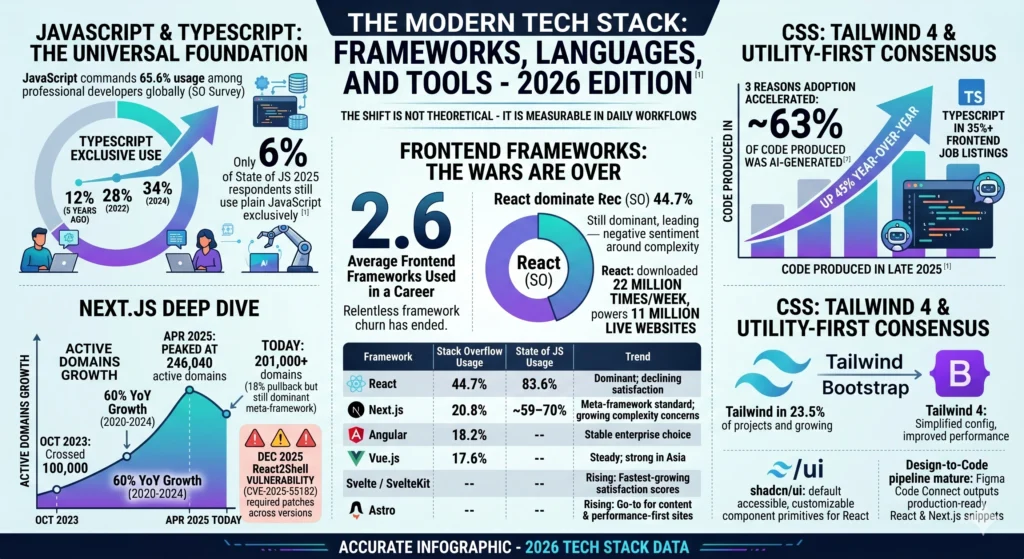
JavaScript has been the dominant programming language for 12 consecutive years, and 2026 is no exception. It commands 65.6% usage among professional developers globally, according to the Stack Overflow Developer Survey. But the more significant story is TypeScript’s rise.
40% of JavaScript developers now write exclusively in TypeScript, up from 34% in 2024 and 28% in 2022 — and a dramatic leap from just 12% five years ago. Only 6% of respondents to the State of JavaScript 2025 survey still use plain JavaScript exclusively. TypeScript now appears in 35%+ of frontend job listings as a hard requirement. For any serious web project starting in 2026, TypeScript is not a preference — it is the default.
Why has adoption accelerated so dramatically? There are three reasons: TypeScript provides the safety net that catches bugs before runtime; it dramatically improves AI-generated code quality because LLMs use types as context; and meta-frameworks like Next.js have made TypeScript essentially mandatory for their full feature sets.
Frontend Frameworks: The Wars Are Over
The State of JavaScript 2025 survey, conducted across 13,002 developers, opens with a notable finding: the era of relentless framework churn has ended. The average respondent has used only 2.6 frontend frameworks in their entire career. As the survey editors put it directly: “The image of the burned-out web developer jumping from framework to framework on a monthly basis isn’t quite accurate anymore.”
React remains dominant at 83.6% usage, but it is not without friction — the survey found React leading all projects in negative developer sentiment, primarily around complexity and state management. Still, React is downloaded more than 22 million times per week from npm and powers over 11 million live websites.
Here is where the major frameworks stand in 2026:
| Framework | Usage (Stack Overflow) | Usage (State of JS) | Trend |
|---|---|---|---|
| React | 44.7% | 83.6% | Dominant; declining satisfaction |
| Next.js | 20.8% | ~59–70% | Meta-framework standard; growing complexity concerns |
| Angular | 18.2% | — | Stable enterprise choice |
| Vue.js | 17.6% | — | Steady; strong in Asia |
| Svelte / SvelteKit | — | Rising | Fastest-growing satisfaction scores |
| Astro | — | Rising | Go-to for content and performance-first sites |
Next.js in particular tells a nuanced story. The framework peaked at 246,040 active domains in April 2025 and remains on 201,000+ domains today, representing an 18% pullback from peak but still the most adopted React meta-framework globally. It crossed 100,000 active domains in October 2023 and grew roughly 60% year-over-year from 2020 to 2024. However, the December 2025 React2Shell vulnerability (CVE-2025-55182) required patches across multiple Next.js versions after active exploitation was confirmed, adding urgency to ongoing complexity concerns.
CSS: Tailwind 4 and the Utility-First Consensus
Tailwind CSS has firmly overtaken Bootstrap in developer satisfaction surveys and now appears in 23.5% of projects — and growing. Tailwind 4 introduced a dramatically simplified configuration approach and improved performance. Alongside it, shadcn/ui has become the default accessible, customizable component primitive library for React applications.
The design-to-code pipeline has also matured. Figma’s Code Connect feature now outputs production-ready React and Next.js snippets directly from design components, making the gap between design and implementation narrower than it has ever been.
AI-First Development: From Copilots to Autonomous Agents
The Numbers Tell the Story
No single force has reshaped web development in 2026 more than artificial intelligence. The shift is not theoretical — it is measurable in daily workflows:
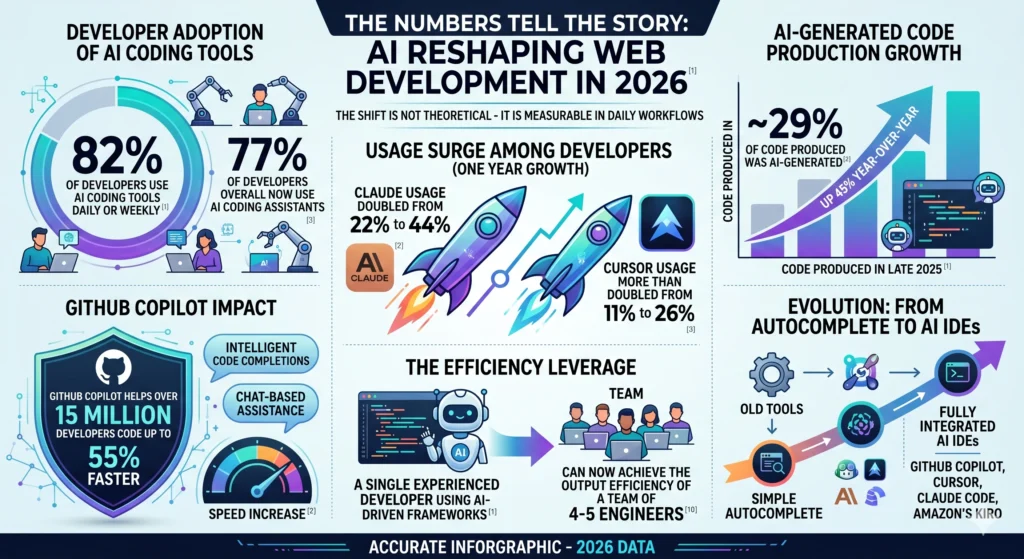
- 82% of developers use AI coding tools daily or weekly
- 77% of developers overall now use AI coding assistants
- ~29% of code produced in late 2025 was AI-generated, up 45% year-over-year
- Claude usage among developers doubled from 22% to 44% in a single year; Cursor more than doubled from 11% to 26%
- GitHub Copilot helps over 15 million developers code up to 55% faster by offering intelligent code completions and chat-based assistance
Tools like GitHub Copilot, Cursor, Claude Code, and Amazon’s Kiro have graduated from simple autocomplete into what developers describe as fully integrated AI IDEs. A single experienced developer using AI-driven frameworks can now achieve the output efficiency of a team of 4–5 engineers.
What AI Is Actually Doing (and Not Doing)
The productivity picture is more nuanced than the headline numbers suggest. While 82% of developers report using AI tools daily, DORA 2024 research shows that AI coding assistants can increase individual developer output in some contexts, but speed gains do not automatically translate into better delivery performance. Some studies have found AI coding agents can make developers 19% slower in certain complex tasks — even when those same developers believe they are 20% faster.
The genuine, measurable gains are in specific domains:
- Documentation quality: +7.5% improvement
- Code review speed: +3.1% improvement
- Code quality (fewer bugs, more maintainable code): +3.4% improvement
- Flow state and focus: +2.6% improvement
- Job satisfaction (fewer repetitive tasks): +2.2% improvement
The nuance is critical for anyone writing or reading about AI in development: AI tools are powerful force multipliers, but they require deliberate integration into the development lifecycle. The teams getting the most out of them treat AI adoption as a system change, not a shortcut.
The Model Context Protocol and Design Integration
One of the most significant workflow shifts in 2026 is the Model Context Protocol (MCP) server, which enables AI agents to read directly from Figma design files and translate design intent into precise, annotated code output. This has effectively automated the design handoff process — not as a one-time sprint event, but as a continuous, always-live sync between design and code.
68% of developers use AI to generate code from design assets such as Figma frames or wireframes. Agent-runner frameworks like BMAD upgrade basic prompting into structured workflows that resemble agile sprints driven by AI agents rather than manual iteration cycles.
AI Agents Inside Web Applications
Beyond development tooling, AI agents are being built into web applications themselves. Gartner has predicted that 40% of enterprise applications will feature task-specific AI agents by 2026, up from less than 5% in 2024. According to industry reports, 57% of organizations already have AI agents in production.
The AI agent market is valued at $10.91 billion in 2026 and projected to reach $52.63 billion by 2030, a compound annual growth rate of 46.3%. Frontend developers are increasingly building systems that expect AI input and output as part of normal operation — generating UI variations, adapting content dynamically, and supporting AI-driven features.
Rendering in 2026: Server-First, Hybrid, and Reactive
The Client-Side Rendering (CSR) vs. Server-Side Rendering (SSR) vs. Static Site Generation (SSG) debate that dominated frontend conversations from 2018 to 2024 is effectively over. In 2026, the answer is hybrid rendering on the same page, orchestrated by the meta-framework.
React Server Components: The Architecture Shift
React Server Components (RSC) changed the fundamental equation of how React applications are built. The first three steps of the traditional client render cycle — download JavaScript, parse JavaScript, fetch data — now happen on the server. The result: rendered HTML arrives in the browser with minimal client JavaScript attached.
A practical example illustrates the impact: Server Components in Next.js have been documented cutting First Contentful Paint from 2.8 seconds to 0.6 seconds in production analytics dashboards. That is a 78% improvement in a single architectural change.
The meta-framework landscape in 2026 is built around server-first principles: React Server Components in Next.js and Remix, Nuxt’s server layers, SvelteKit’s server routes, Astro’s zero-JS-by-default Islands architecture. All of them point in the same direction — ship less JavaScript to the browser, render more on the server, cache aggressively at the edge.
The React Compiler: The End of Manual Memoization
One of the most anticipated developer experience improvements is the React Compiler, now available in Next.js 16+. Its purpose is to eliminate the need for manual memoization — the useMemo, useCallback, and React.memo calls that have frustrated React developers for years. The compiler analyzes component trees and automatically applies performance optimizations at build time, reducing cognitive overhead while improving rendering performance.
The Build Toolchain: Vite, Bun, and the End of Webpack’s Dominance
Vite Has Won the New-Project Battle
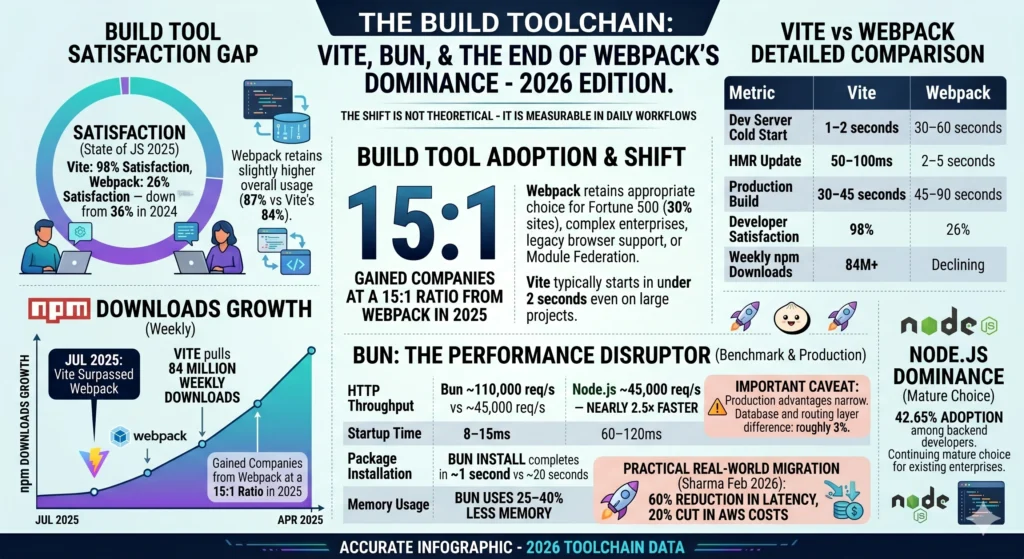
The State of JavaScript 2025 survey identified Vite as the headline story in build tooling. While Webpack retains slightly higher overall usage (87% vs Vite’s 84%), the satisfaction gap is staggering: Vite scores 98% satisfaction; Webpack scores just 26% — down from 36% in 2024. In npm download volume, Vite surpassed Webpack in July 2025 and now pulls 84 million weekly downloads. It gained companies from Webpack at a 15:1 ratio in 2025.
The performance difference is architectural. When you run npm run dev, Vite typically starts in under 2 seconds even on large projects. Webpack can take 30 seconds to several minutes. Vite’s Hot Module Replacement (HMR) reflects changes in under 100ms; Webpack’s takes 2–5 seconds. Over hundreds of file saves per day, this adds up to hours of reclaimed developer time.
| Metric | Vite | Webpack |
|---|---|---|
| Dev Server Cold Start | 1–2 seconds | 30–60 seconds |
| HMR Update | 50–100ms | 2–5 seconds |
| Production Build | 30–45 seconds | 45–90 seconds |
| Developer Satisfaction | 98% | 26% |
| Weekly npm Downloads | 84M+ | Declining |
Webpack is not dead — it still holds 30% of Fortune 500 sites and remains the appropriate choice for complex enterprise builds with highly customized pipelines, legacy browser support requirements, or deep Module Federation needs. But for any new project starting in 2026, Vite is the pragmatic default choice.
Bun: The Performance Disruptor
Bun is no longer an experimental runtime. In 2026, it is a mature, production-ready JavaScript runtime that has fundamentally changed the performance expectations for JavaScript infrastructure.
The benchmarks are striking:
- HTTP throughput: Bun handles ~110,000 requests/second vs Node.js’s ~45,000 — nearly 2.5× faster
- Startup time: 8–15ms for Bun vs 60–120ms for Node.js
- Package installation:
bun installcompletes in ~1 second vs ~20 seconds for npm - Memory usage: Bun uses 25–40% less memory for API servers
A practical real-world migration validated these numbers: in February 2026, software engineer Sachin Sharma migrated microservices to Bun and documented a 60% reduction in latency and a 20% cut in AWS costs.
The important caveat: synthetic benchmark advantages (4× HTTP throughput) narrow considerably in production. Strapi’s comprehensive analysis found that when database and routing layers are involved, the real-world HTTP performance difference narrows to roughly 3%. Bun’s advantages are most compelling for serverless functions, edge computing, and package-manager-heavy workflows — less so for CPU-bound SSR.
Node.js, for its part, remains dominant at 42.65% adoption among backend developers and continues to be the safest, most mature choice for existing enterprise applications.
Edge Computing and WebAssembly
Edge Computing: Code at the Boundary
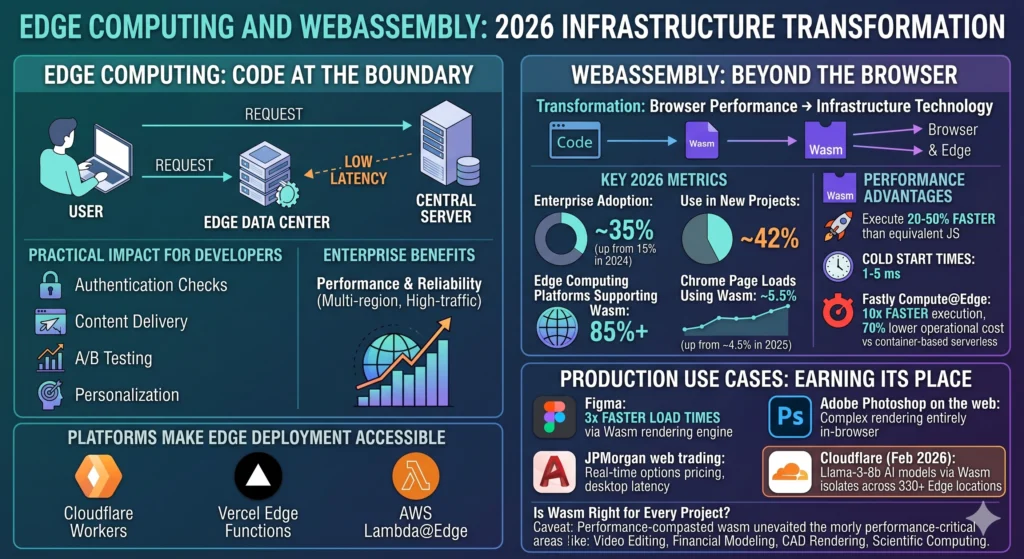
Edge computing has moved from experimentation to production standard. The concept is straightforward: instead of routing every user request to a central server, code runs at the network edge — in data centers physically close to the user. Platforms like Cloudflare Workers, Vercel Edge Functions, and AWS Lambda@Edge have made edge deployment accessible to any development team.
For web developers, the practical impact is significant. Authentication checks, content delivery, A/B testing, and personalization can all happen at the edge — without requests hitting a central server. For enterprise organizations managing content across multiple regions or high-traffic moments, edge computing is both a performance improvement and a reliability improvement.
WebAssembly: Beyond the Browser
WebAssembly (Wasm) is undergoing one of the more quietly significant transformations in the web technology stack. It began as a way to run compiled languages in the browser at near-native speed, and it is now becoming a fundamental infrastructure technology.
Current adoption metrics in 2026:
- Enterprise adoption: ~35% (up from 15% in 2024)
- Use in new projects: ~42%
- Edge computing platforms supporting Wasm: 85%+
- Chrome page loads using Wasm: ~5.5% (up from ~4.5% a year earlier)
The performance characteristics make Wasm compelling for specific use cases. WebAssembly modules execute 20–50% faster than equivalent JavaScript in compute-heavy scenarios. Wasm cold start times run 1–5 milliseconds — approximately 100× faster than traditional containers. Fastly Compute@Edge benchmarks put Wasm execution at 10× faster than container-based serverless, at 70% lower operational cost.
The production use cases show where Wasm is earning its place:
- Figma uses a C++ rendering engine via Wasm, achieving 3× faster load times
- Adobe Photoshop on the web handles complex rendering entirely in-browser via Wasm
- JPMorgan’s web trading platform uses Wasm modules for real-time options pricing, achieving desktop-application latency in the browser
- Autodesk’s web-based AutoCAD relies on Wasm for geometry processing and 3D rendering
- Google deploys Wasm across Maps, Earth, Meet, and Photos
- In February 2026, Cloudflare used Wasm-based V8 isolates to deploy Llama-3-8b AI models across 330+ global edge locations
Wasm is not for every project. The learning curve is steep, and choosing which parts of an application should use Wasm versus JavaScript requires careful analysis. For performance-critical components — in-browser video editing, financial modeling, CAD rendering, scientific computing — the benefits are now well-documented and production-proven.
Modern Developer Workflows: CI/CD, DevOps, and Design-to-Code
CI/CD: Standard Practice, Now AI-Augmented
Continuous Integration and Continuous Delivery (CI/CD) is no longer an advanced practice — it is a standard expectation. 55% of developers regularly use CI/CD tools (JetBrains State of Developer Ecosystem 2025). Infrastructure as Code (Terraform, CloudFormation, Ansible) is a core DevOps requirement, with everything from server configuration to deployment pipelines defined as code and version-controlled alongside application code.
The emerging development in CI/CD is AI augmentation. Teams are reporting a 40% reduction in build times through AI-driven CI/CD optimization. AI tools analyze historical build data, identify bottleneck patterns, and automatically reorder test execution to surface failures faster. Advanced deployment strategies — blue-green deployments, canary releases, automated rollbacks — are now considered table stakes rather than advanced practices.
Platform Engineering has emerged as the hidden engine behind high-performing DevOps organizations: dedicated internal teams that standardize CI/CD tooling, internal developer platforms, and deployment pipelines at the company level, freeing product teams from infrastructure concerns.
The Complete Modern Workflow
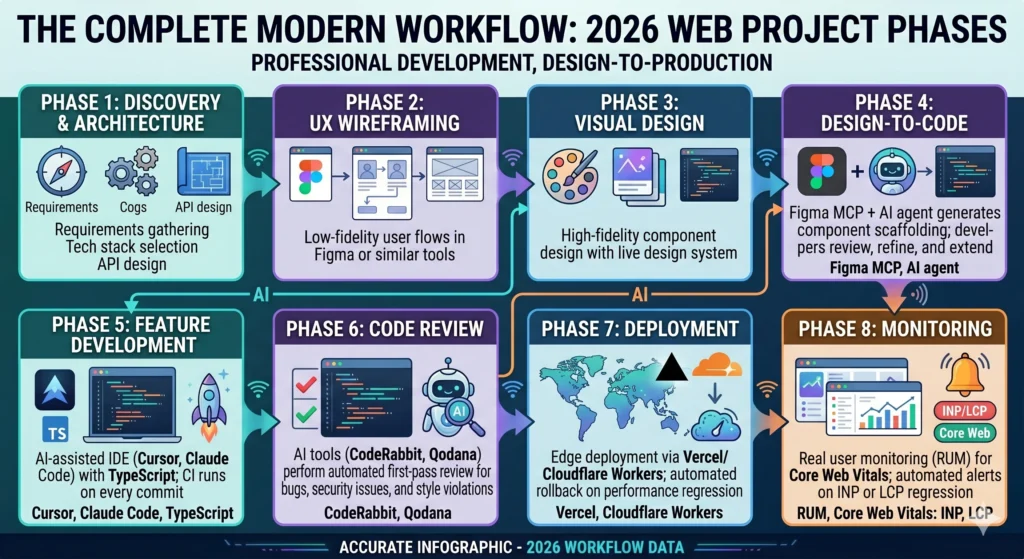
The design-to-production workflow for a professional web project in 2026 follows roughly these phases:
- Discovery and architecture — requirements gathering, tech stack selection, API design
- UX wireframing — low-fidelity user flows in Figma or similar tools
- Visual design — high-fidelity component design with live design system
- Design-to-code — Figma MCP + AI agent generates component scaffolding; developers review, refine, and extend
- Feature development — AI-assisted IDE (Cursor, Claude Code) with TypeScript; CI runs on every commit
- Code review — AI tools (CodeRabbit, Qodana) perform automated first-pass review for bugs, security issues, and style violations
- Deployment — edge deployment via Vercel/Cloudflare Workers; automated rollback on performance regression
- Monitoring — real user monitoring (RUM) for Core Web Vitals; automated alerts on INP or LCP regression
Performance: Core Web Vitals and What Google Actually Measures
The Three Metrics That Define SEO in 2026
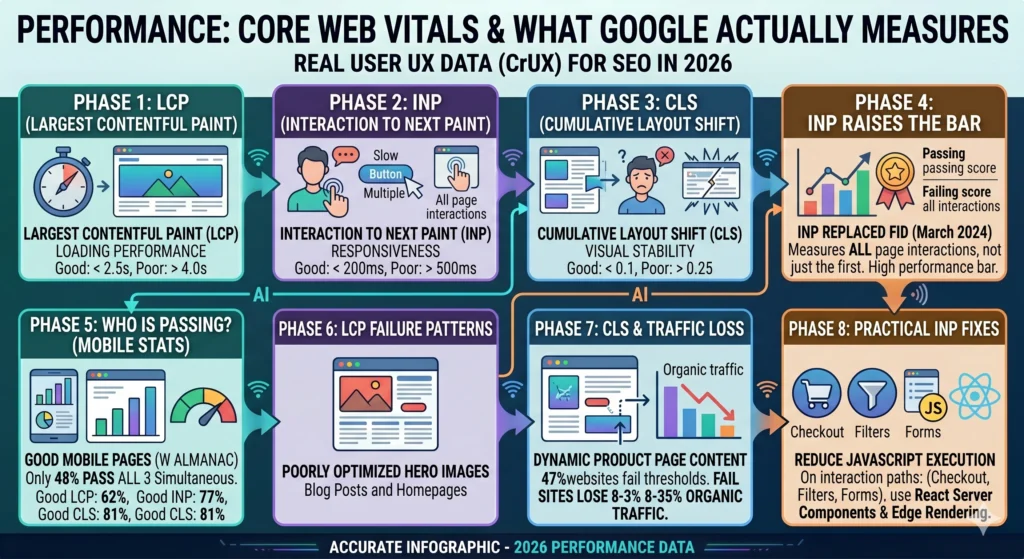
Google’s Core Web Vitals are three user experience metrics that directly influence search rankings. All three are evaluated using real user data from the Chrome User Experience Report (CrUX) — not lab simulations. This is a critical distinction: PageSpeed Insights scores alone do not move rankings.
| Metric | What It Measures | Good Threshold | Poor Threshold |
|---|---|---|---|
| LCP (Largest Contentful Paint) | Loading performance | < 2.5 seconds | > 4.0 seconds |
| INP (Interaction to Next Paint) | Responsiveness | < 200ms | > 500ms |
| CLS (Cumulative Layout Shift) | Visual stability | < 0.1 | > 0.25 |
INP replaced First Input Delay (FID) in March 2024, and it significantly raised the bar — it measures all page interactions, not just the first. A page that responds slowly to a second or third user click will now fail, where it previously would have passed.
Who Is Passing — and Who Is Not
The 2025 Web Almanac data paints a sobering picture:
- Only 62% of mobile pages achieve a good LCP score — making it the hardest metric to pass
- 77% of mobile pages achieve a good INP score
- 81% of mobile pages achieve a good CLS score
- Only 48% of mobile pages pass all three Core Web Vitals simultaneously
A separate analysis found that 47% of websites fail Core Web Vitals thresholds — and those sites lose between 8% and 35% of organic traffic as a result.
The failure patterns are consistent:
- LCP failures concentrate on blog posts and homepages with poorly optimized hero images
- INP failures concentrate on pages with heavy JavaScript interactions — checkouts, filters, forms
- CLS failures concentrate on product pages with dynamic content that loads asynchronously
The practical fix for most INP failures is reducing JavaScript execution on interaction paths — which, conveniently, is exactly what React Server Components and edge rendering help accomplish.
Progressive Web Apps: The Market Hits Maturity
Progressive Web Apps (PWAs) sit at an interesting inflection point in 2026. The underlying technology has fully matured — service workers, web app manifests, push notifications, and offline capabilities are now well-supported across all major browsers. The business case is well-documented: Alibaba integrated PWA technology and saw conversions increase 76% across all web browsers alongside significant growth in active users on both iOS and Android.
The market reflects this confidence. The global PWA market was valued at $3.7 billion in 2026 and is projected to reach $18.9 billion by 2034, expanding at a 22.5% CAGR. The PWA Development Software Market specifically is valued at $5.2 billion in 2026 and projected to reach $30.1 billion by 2033.
The value proposition for businesses is straightforward: a single PWA codebase serves web, mobile, and tablet without the cost of maintaining separate iOS and Android applications. PWAs load quickly even on low-bandwidth networks, support offline functionality, and are discoverable through standard web search — advantages native apps cannot match.
The projected 55% adoption rate of PWAs by businesses in 2026 reflects the technology’s transition from “promising experiment” to “standard practice for mobile web.”
Security: Zero Trust Is No Longer Optional
The “Never Trust, Always Verify” Standard
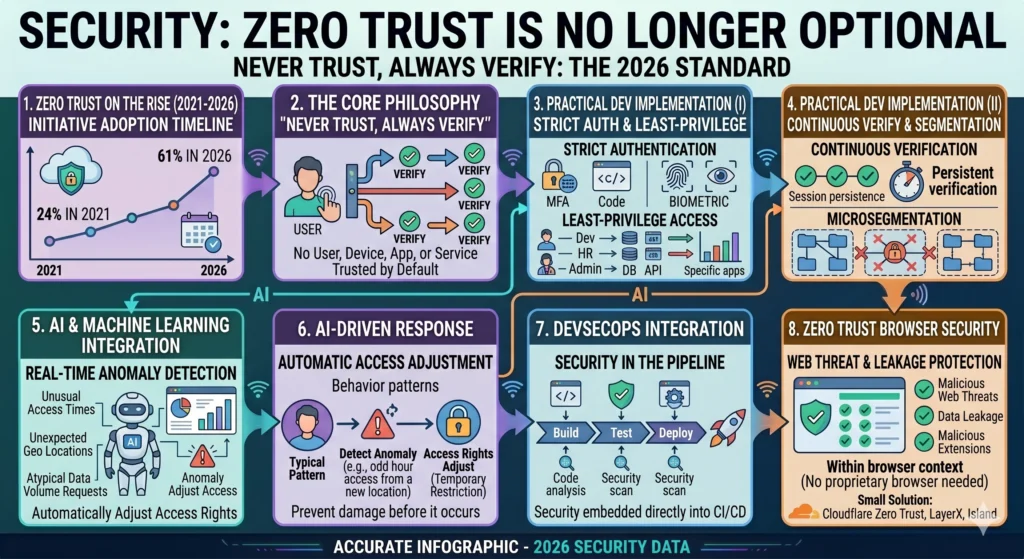
The traditional security model — trust everything inside the network perimeter — has proven inadequate for a world of cloud-native applications, remote work, and distributed teams. 61% of organizations now have a defined Zero Trust security initiative, a dramatic increase from just 24% in 2021.
Zero trust operates on a simple but demanding principle: no user, device, application, or service — inside or outside the network — should be trusted by default. Every access request must be continuously verified, every session actively monitored, every user granted only the minimum privilege necessary to do their job.
For web developers, the practical implementation means:
- Strict authentication: Multi-factor authentication and biometric verification at every access point
- Least-privilege access: Users and applications access only what they absolutely need
- Continuous verification: Authentication is not a one-time login event; it persists through the session
- Microsegmentation: Network segments are isolated so a breach in one area cannot spread laterally
- DevSecOps integration: Security embedded directly into CI/CD pipelines, not bolted on at the end
AI and Zero Trust
A significant development in 2026 is the integration of AI and machine learning into zero trust identity management. AI systems analyze behavioral patterns in real time, detecting anomalies that would be invisible to static rules — unusual access times, unexpected geographic locations, atypical data volume requests — and automatically adjusting access rights before damage can occur.
Zero trust browser security solutions (Cloudflare Zero Trust, LayerX, Island) protect against web-borne threats, data leakage, and malicious extensions directly within the browser context, without requiring proprietary browsers.
Sustainable Web Development
The Carbon Cost of the Web
The environmental impact of the web is a growing engineering and business concern in 2026. The internet accounts for approximately 4% of global CO2 emissions, and an average website produces 1.76 grams of CO2 per page view. Data centers consume roughly 3% of the global electricity supply and account for approximately 2% of greenhouse gas emissions.
For a website with one million monthly page views, that averages to over 21,000 kg of CO2 annually — before factoring in server computation, data transfer, and device rendering. Scaled across the entire web, the environmental cost is significant.
Performance and Sustainability Are the Same Problem
The most important insight in sustainable web development is that performance optimization and sustainability are not separate initiatives — they are the same work:
- Image optimization: WebP and AVIF formats save 50–80% file size compared to JPEG/PNG, reducing both page load time and data transfer energy
- Green hosting: Switching to a host that uses renewable energy can cut a site’s carbon footprint by up to 90%
- Lean code: Smaller JavaScript bundles mean less CPU computation on user devices — lower energy, faster rendering, and better Core Web Vitals scores simultaneously
- Edge computing and CDNs: Serving content from geographically distributed edge nodes reduces the distance data travels, cutting energy consumption while improving latency
- Efficient frameworks: Framework selection directly influences how much energy a website consumes across thousands or millions of visits
EU regulatory frameworks are increasingly incorporating digital responsibility standards. Sustainable web development is transitioning from an ethical preference to a compliance concern for enterprises operating in European markets.
Free tools like the Website Carbon Calculator and Google Lighthouse allow developers to measure and track emissions per page view alongside performance metrics.
The Evolving Role of the Developer
From Code Writer to Architect and Orchestrator
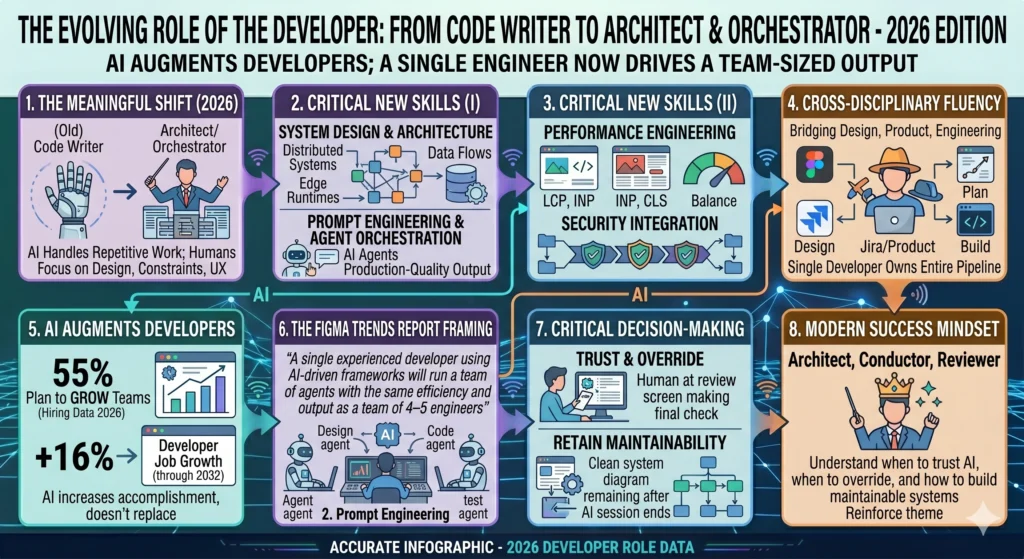
The developer’s role in 2026 has shifted in a meaningful and irreversible way. AI tools handle the mechanical, repetitive, syntactically routine work of software development. Developers increasingly focus on architecture, system design, constraints, and user experience.
This is not a reduction in the value of developers — it is a redefinition. The skills that are becoming more important include:
- System design and architecture: Understanding how distributed systems, edge runtimes, and data flows interact
- Prompt engineering and agent orchestration: Knowing how to give AI agents context that produces reliable, production-quality output
- Performance engineering: Reading Core Web Vitals field data, identifying root causes, making decisions that balance UX, speed, and cost
- Security integration: Embedding security practices into CI/CD pipelines rather than treating them as a separate audit process
- Cross-disciplinary fluency: Bridging design, product, and engineering — increasingly, a single developer can own this entire pipeline with AI support
AI Augments, Not Replaces
The data consistently supports one conclusion: AI tools augment developers; they do not replace them. Companies are still hiring — 55% plan to grow development teams in 2026. Developer job growth is projected at +16% through 2032, far above the average for all occupations.
The most accurate framing comes from the Figma 2026 trends report: “A single experienced developer using AI-driven frameworks will run a team of agents with the same efficiency and output as a team of 4–5 engineers”. That is not a reduction in developers. It is an increase in what a developer can accomplish.
The developers who will thrive in this environment are those who understand when to trust AI output, when to override it, and how to build systems that remain maintainable after the AI session ends.
Key Takeaways and Recommendations
For Individual Developers
Learn TypeScript if you haven’t. It is the professional standard. 40% of developers write exclusively in TypeScript; only 6% use plain JavaScript exclusively. Every serious frontend role requires it.
Adopt Vite for new projects. The performance and developer experience advantages over Webpack are real and documented. A 98% satisfaction score versus 26% is not a close call.
Integrate AI tools deliberately. Use Cursor, Claude Code, or GitHub Copilot — but treat them as junior pair-programmers that require review, not as autonomous code generators. The teams seeing genuine productivity gains are those who have structured AI integration, not those who simply installed a plugin.
Understand Server Components. React Server Components and the Next.js App Router are production-ready and represent the architectural direction of the web. Understanding the server/client component boundary is now a fundamental skill.
Benchmark against Core Web Vitals. Set up real user monitoring. A PageSpeed Insights score doesn’t move rankings — CrUX field data does.
For Development Teams and Organizations
Invest in Platform Engineering. The highest-performing DevOps organizations have dedicated platform teams. Standardized CI/CD tooling, internal developer platforms, and deployment automation compound in value over time.
Adopt zero trust security architecture now. If your organization is still operating with perimeter-based security, that is an active risk. 61% of organizations have a defined zero trust initiative; the remaining 39% are exposed.
Treat performance and sustainability as infrastructure decisions. The choice of framework, image format, hosting provider, and delivery architecture directly determines both Core Web Vitals scores and carbon emissions. These decisions compound across millions of user sessions.
Build with AI as a target user. Frontend developers are now building systems that expect AI input and output as part of normal operation. Whether that means generating UI variations, powering recommendation engines, or supporting conversational interfaces — AI-readiness is a product requirement, not just a development tool.
The Three Things That Will Define Web Development for the Next Two Years
- AI agents will become standard components of web applications — not just development tools, but first-class features delivering personalization, automation, and intelligence at scale
- Edge rendering will become the default — the combination of server components, edge functions, and Wasm cold starts measured in milliseconds means the fully centralized server model will be reserved for specialized legacy use cases
- TypeScript, React, and Next.js will remain dominant — but developer satisfaction will push adoption of Svelte, Astro, and SolidJS for performance-critical and content-heavy use cases where the React model’s overhead becomes visible
The web development industry in 2026 is not in chaos — it has matured. The frameworks, languages, and architectural patterns that will define the next three to five years are largely visible today. The opportunity is in mastering them, applying them deliberately, and building systems that will still be maintainable when the next wave of tooling arrives.
Sources: State of JavaScript 2025 (Devographics / InfoQ), Stack Overflow Developer Survey 2025, Figma 2026 Web Development Trends Report, JetBrains State of Developer Ecosystem 2025, 2025 Web Almanac (HTTP Archive), DORA 2024, Colorlib Web Development Statistics 2026, Strapi State of JS Analysis, Uno Platform State of WebAssembly 2025–2026, and industry publications from LogRocket, Agility CMS, Talent500, and others.