
Perplexity Health: The Powerful AI Health Agent Explained
Disclaimer: This article is for informational purposes only. Perplexity Health is an educational health tool and is not intended to diagnose, treat, or prevent any condition. Nothing in this article constitutes medical advice. Always consult a qualified clinician before making any health-related decisions.
What Is Perplexity Health? (And Why Perplexity Built It)
Perplexity Health is a personalized AI health agent launched in March 2026 that connects a user’s electronic health records (EHRs), Apple Health data, wearable device metrics, and lab results into a single interface — then uses that combined picture to deliver contextual, cited answers to health questions. Rather than returning generic population-level information, the system grounds its responses in what is actually in your medical history.
The Problem It’s Solving
Personal health data has always been fragmented. Lab results live in one patient portal, prescriptions in another, fitness data across a separate app, and past visit notes in a third system. When someone searches for information about their resting heart rate, they typically get advice calibrated to an average adult — not to their cardiac history, recent bloodwork, or overnight sleep data. Perplexity’s bet is that meaningful health answers require all of that information at once.
This is not a novel insight; it reflects a structural reality. According to Perplexity’s own announcement, millions of people already turn to AI to ask health questions daily, but the answers are untethered from the person asking. Perplexity Health’s stated purpose is to change that.
Why Perplexity, and Why Now
Perplexity Health follows a clear competitive pattern in early 2026. OpenAI launched ChatGPT Health with Apple Health integration in January 2026, and Microsoft launched Copilot Health on March 12, 2026. Perplexity Health arrived one week later, on March 19, making it the second major AI platform to support Apple Health integration. The category is moving fast, and each company is racing to establish the default interface through which people interact with their own health data.
Perplexity Health is built on top of Perplexity Computer, the company’s agentic AI platform that orchestrates 19 different AI models to complete complex multi-step tasks autonomously. Health is the second major personal data vertical Perplexity has built on this infrastructure, following Perplexity Finance, which used Plaid for brokerage account integration.
Perplexity Health Features: What Data Can It Connect and What Can It Do?
At launch, Perplexity Health supports four categories of health data input, each powered by a distinct integration partner.
Data Connectors
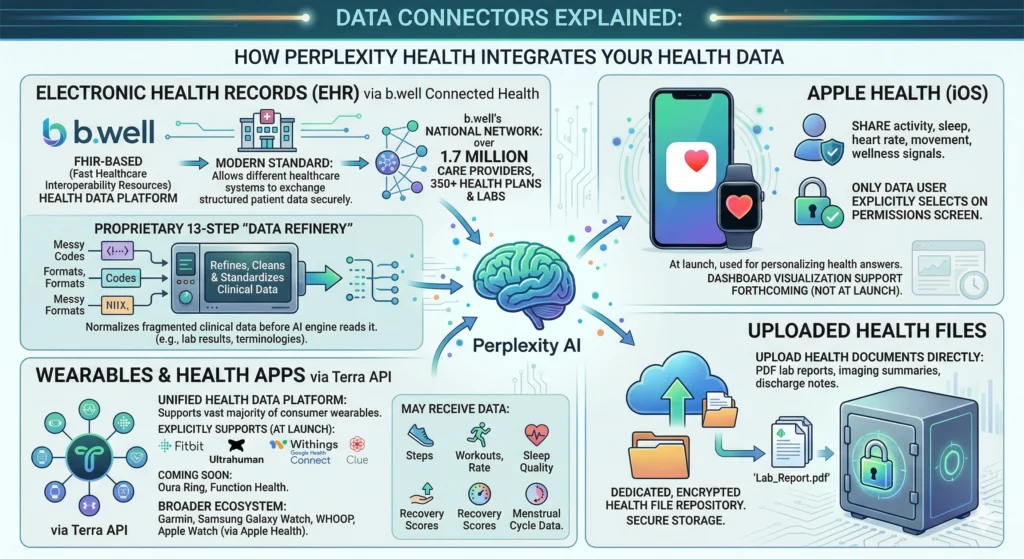
Electronic Health Records (EHR) via b.well Connected Health
EHRs are connected through Perplexity’s partnership with b.well Connected Health, a FHIR-based (Fast Healthcare Interoperability Resources) health data platform. FHIR is the modern standard that allows different healthcare systems — hospitals, labs, insurance plans — to exchange structured patient data securely. Through b.well’s national network, users can authorize access to records from over 1.7 million care providers and more than 350 health plans and labs across the United States.
A key piece of b.well’s infrastructure is its proprietary 13-step “Data Refinery,” which cleans and standardizes fragmented clinical data before the AI engine reads it. This matters because raw EHR data from different providers often uses different codes, formats, and terminology — a lab result from one system may be labeled differently in another. The refinery process normalizes this so Perplexity’s AI can reason over it accurately.
Apple Health (iOS)
Users on iOS can connect Apple Health to share activity, sleep, heart rate, movement, and other wellness signals. Only data the user explicitly selects on the Apple Health permissions screen is shared. At launch, Apple Health data is used to personalize health answers but is not reflected in the visual Health Hub dashboard — Perplexity has indicated dashboard visualization support is forthcoming.
Wearables and Health Apps via Terra API
Wearable device and fitness app data is pulled through Terra API, a unified health data platform that supports the vast majority of consumer wearables on the market. At launch, Perplexity Health explicitly supports Fitbit, Ultrahuman, and Withings, along with integration points for Google Health Connect and Clue. Oura Ring and Function Health integrations are confirmed as coming soon. Through Terra API’s broader ecosystem, devices such as Garmin, Samsung Galaxy Watch, WHOOP, and Apple Watch (via Apple Health) are also accessible.
Depending on the device and user permissions granted, Perplexity may receive data including steps, workouts, heart rate, sleep quality, recovery scores, and menstrual cycle data.
Uploaded Health Files
Users can upload health documents — such as PDF lab reports, imaging summaries, or discharge notes — directly to a dedicated, encrypted health file repository within the platform.
Best wearables and health devices for Perplexity Health
If you want Perplexity Health to work with real-world data like sleep, heart rate, workouts, recovery, and cycle tracking, these are the strongest consumer devices to recommend right now across Apple, Samsung, Garmin, and ring-based health tracking.
Apple Watch Series 11 [GPS 42mm]
Rose Gold Aluminum Case with Light Blush Sport Band, sleep score, fitness tracking, health monitoring, always-on display, and water resistance.
A strong choice for readers in the Apple ecosystem who want broad health tracking, excellent Apple Health integration, and an easy all-in-one smartwatch for daily wear.
Check price on AmazonSamsung Galaxy Watch 8 (40mm)
Bluetooth smartwatch with GPS, sleep coaching, running coach, energy score, heart rate tracking, and cushion design.
Ideal for Android users who want a modern smartwatch with strong fitness features, Samsung Health compatibility, and practical coaching tools for sleep and exercise.
Check price on AmazonGarmin Venu 4 (45mm)
Advanced health and fitness GPS smartwatch with 1.4-inch AMOLED display, built-in flashlight, and up to 12 days of battery life.
Best for runners, gym users, and data-focused buyers who want stronger training metrics, longer battery life, and a more fitness-first wearable than a standard smartwatch.
Check price on AmazonOura Ring 4
Rose Gold, Size 8, tracks sleep, activity, women’s health, and recovery, with AI advisor support and up to 8 days of battery life.
A great option for readers who care most about sleep quality, recovery insights, readiness trends, and a less distracting wearable than a smartwatch.
Check price on AmazonWhat the System Can Do
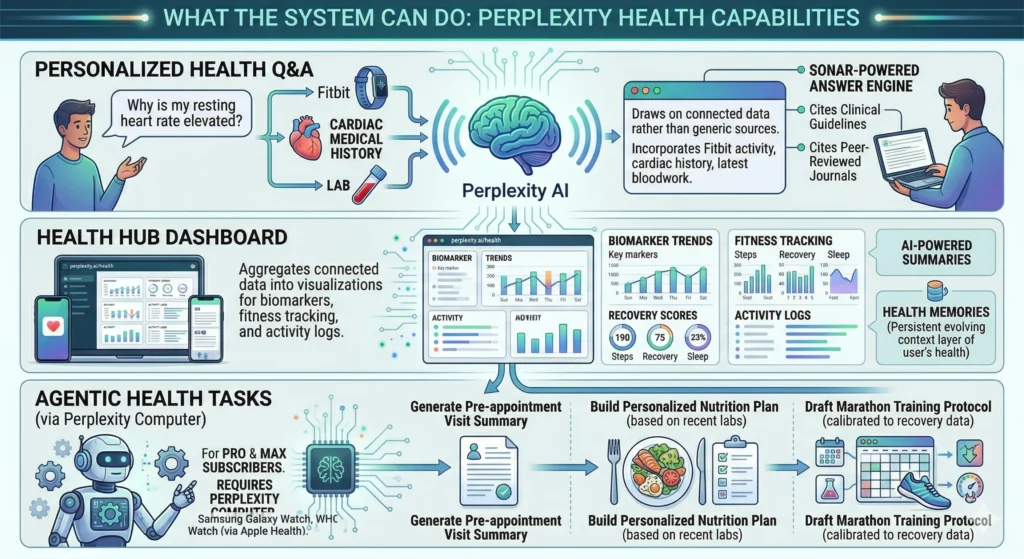
Once health data is connected, Perplexity Health enables several distinct capabilities:
Personalized Health Q&A: When a user asks a health question, the Sonar-powered answer engine draws on the connected data rather than generic sources. A query like “Why is my resting heart rate elevated?” can simultaneously incorporate recent activity from a Fitbit, cardiac history from an EHR, and the latest bloodwork from a lab. All responses cite clinical guidelines and peer-reviewed journals, making it possible to trace exactly where each claim originated.
Health Hub Dashboard: Available at perplexity.ai/health, the dashboard aggregates connected data into visualizations for biomarker trends, fitness tracking, and activity logs over time. It also generates AI-powered summaries and maintains “health memories” — a persistent context layer that gives Perplexity an evolving picture of the user’s health over time.
Agentic Health Tasks (via Perplexity Computer): For Pro and Max subscribers who also use Perplexity Computer, the agent layer can take the connected health data and execute more complex outputs autonomously: generating a pre-appointment visit summary, building a personalized nutrition plan based on recent labs, or drafting a marathon training protocol calibrated to recovery data.
Is Perplexity Health Safe? Privacy, Security, and HIPAA Considerations
Privacy in health AI is not a secondary concern — it is the primary concern. Here is what is known about how Perplexity handles health data, and where the important limits are.
How Your Data Is Stored and Protected
Perplexity states that raw health data is not stored permanently on its servers. Instead, the system queries data on demand through its integration partners (b.well and Terra API) when a user makes a request. Uploaded health files are stored in a separate, encrypted health file repository.
Key security commitments Perplexity has stated publicly:
- Health data is encrypted in transit and at rest
- Strict access controls are in place, limiting which system components can access health data
- Health data is never used to train AI models
- Health data is never sold to third parties
- Users can disconnect any data source or delete their information at any time
- Perplexity is SOC 2 Type II certified, verified by independent auditors
- Perplexity is GDPR compliant
The HIPAA Question (Read This Carefully)
HIPAA — the Health Insurance Portability and Accountability Act — is the U.S. law that governs how protected health information (PHI) must be handled by covered entities (hospitals, insurers) and their business associates. This is where many users are confused.
Perplexity Health is a consumer product, and HIPAA technically does not apply to consumer health applications in the same way it applies to clinical providers. Perplexity’s help documentation explicitly states: “HIPAA does not apply to consumer health products like Perplexity Health. However, your data is protected with end-to-end encryption and strict security practices that Perplexity follows.”
For healthcare organizations using Perplexity at the enterprise level (processing actual PHI), HIPAA compliance is available only when a Business Associate Agreement (BAA) is executed under an Enterprise plan. The enterprise terms explicitly prohibit processing PHI without a signed BAA.
What this means in practice: Perplexity Health uses security practices aligned with healthcare-grade standards, and the b.well integration specifically is a HIPAA-compliant platform. But users connecting their personal health data through the consumer Pro or Max tier are not covered by HIPAA the way their hospital’s patient portal is. They are relying on Perplexity’s contractual privacy commitments rather than federal regulatory enforcement.
This is the same structural reality that applies to ChatGPT Health, Apple Health, and virtually every consumer health app on the market. It is not unique to Perplexity, but it is worth understanding clearly before connecting sensitive data.
What Perplexity Health Cannot Do — And Should Not Be Asked to Do
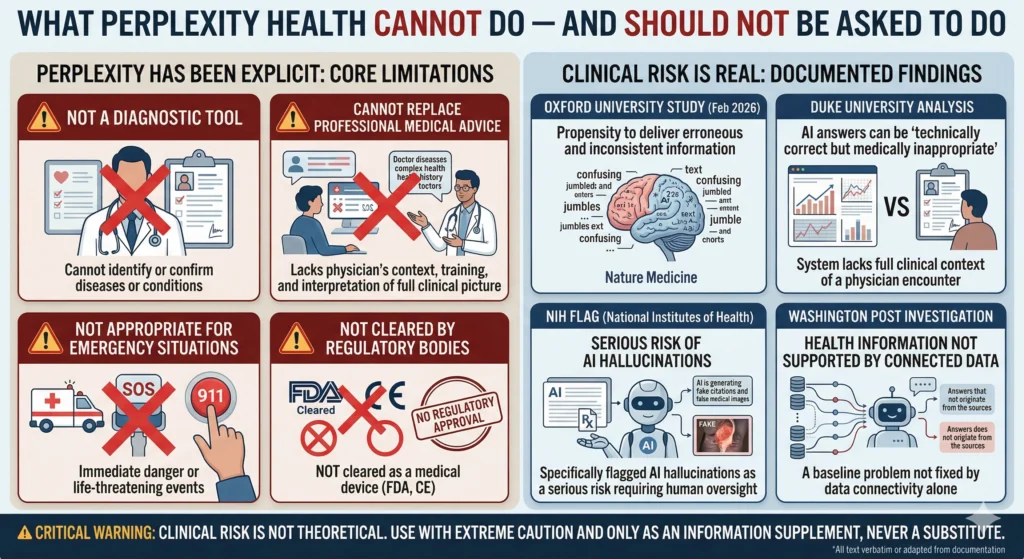
Perplexity has been explicit in its official documentation and advisory board announcement:
- It is not a diagnostic tool
- It cannot replace professional medical advice
- It is not appropriate for emergency situations
- It is not cleared by any regulatory body (FDA, CE) as a medical device
The clinical risk is real, not theoretical. An Oxford University study published in Nature Medicine in February 2026 found that AI chatbots showed a “propensity to deliver erroneous and inconsistent information” in health contexts. A separate Duke University analysis found that AI answers can be “technically correct but medically inappropriate” because the system lacks the full clinical context a physician holds during an actual patient encounter. A Washington Post investigation found ChatGPT gave health information not supported by the connected data it had been given — a baseline problem that data connectivity alone does not fix.
The National Institutes of Health (NIH) has specifically flagged AI hallucinations in health care as a serious risk requiring human oversight.
The Health Advisory Board as a Governance Layer
To manage these risks structurally, Perplexity launched a Health Advisory Board alongside the product. The first four named members, announced in March 2026, are:
- Dr. Eric Topol — cardiologist, Scripps Research, author of Deep Medicine, one of the world’s most cited researchers in digital medicine
- Dr. Devin Mann — professor at NYU Grossman School of Medicine; strategic director of digital health innovation at NYU Langone Health
- Dr. Wendy Chung — Mary Ellen Avery Professor of Pediatrics at Harvard Medical School; Chief of Pediatrics at Boston Children’s Hospital
- Tim Dybvig — health technology founder and operator
The board’s mandate is to pressure-test product decisions, content quality, patient safety guardrails, and clinical workflow alignment against evidence-based medicine standards. Its existence does not guarantee error-free outputs, but it is a meaningful governance layer that distinguishes Perplexity Health from a general-purpose chatbot with a health-themed interface.
How to Set Up and Use Perplexity Health: A Step-by-Step Guide
Prerequisites
- A Perplexity Pro ($20/month) or Max ($200/month) subscription
- For full agentic features, Perplexity Max is required (Perplexity Computer access)
- An iPhone running iOS (for Apple Health integration)
- US residency at initial launch
Step 1: Navigate to the Health Hub
Go to perplexity.ai/health in a web browser, or open the Perplexity iOS app. Pro and Max subscribers will see the Health hub in their navigation. If you are on a Free plan, you will need to upgrade first.
Step 2: Connect Your Electronic Health Records
- From the Health hub, select Medical Records (powered by b.well)
- You will be directed to b.well’s authorization flow, which searches for your records across its network of over 1.7 million providers
- Verify your identity using the information your provider has on file
- Select which records or providers to authorize — you do not have to connect everything at once
- Confirm the permissions. Perplexity will now be able to include your EHR data (lab results, visit summaries, medication lists, clinical history) when you ask relevant health questions
Step 3: Connect Wearables and Health Apps
- From the Health hub, select Connectors → Health Devices and Apps
- Choose your device or app from the supported list (Fitbit, Withings, Ultrahuman, Google Health Connect, Clue, and more)
- Authenticate with your device account credentials through Terra API’s secure flow
- Grant the specific data permissions you are comfortable sharing — steps, sleep, heart rate, workouts, recovery, etc.
- Repeat for additional devices if needed
Step 4: Connect Apple Health (iOS Only)
- On the iOS app, you will be prompted to connect Apple Health during the onboarding flow when you first ask a health question, or you can enable it manually via Connectors → Apple Health
- On the Apple Health permissions screen that appears, select specifically which data categories to share (activity, sleep, heart rate, etc.)
- Only the categories you explicitly select will be accessible to Perplexity
Step 5: Upload Health Files (Optional)
For lab reports, imaging summaries, or other documents not accessible via the EHR connector, use the Upload Health Files option in the Health hub. These are stored in a separate encrypted repository.
Step 6: Ask Effective Health Questions
How you phrase questions significantly affects the quality of responses. Here are practical examples of the types of queries Perplexity Health is designed for:
- “My last HbA1c was 5.9%. My resting heart rate has been higher than usual this month. What does that pattern suggest, and what should I discuss with my doctor?”
- “My ferritin came back at 14 ng/mL. My Fitbit shows I’ve been averaging 6.5 hours of sleep. Are these related? What does the research say?”
- “Can you create a pre-appointment summary for my upcoming cardiology visit based on my recent labs and activity data?”
- “Based on my sleep and recovery data from the past month, am I overtraining?”
Avoid asking the system to diagnose a symptom you are experiencing right now, or to tell you whether to take or stop a medication. These are clinical decisions, and the tool is not designed for them.
Step 7: Review, Act — Then Confirm With Your Clinician
Use the Health Hub dashboard to review biomarker and activity trends over time. Use AI-generated summaries to prepare for appointments and to understand what your data means at a high level. Then bring those insights into a conversation with your doctor, who can apply clinical judgment that no AI system currently replicates safely.
Who Should Use Perplexity Health — And What Are Its Limitations?
Who Gets the Most Value
Perplexity Health is best suited for users who:
- Have fragmented health data across multiple systems and want a unified view — multiple providers, insurers, and wearables
- Receive lab results and want help understanding what the numbers mean in context, without waiting for a follow-up appointment
- Use wearables actively (Apple Watch, Fitbit, Withings, Ultrahuman) and want AI-driven synthesis of that data alongside clinical history
- Prepare frequently for medical appointments and want structured summaries that help them ask better questions
- Manage chronic conditions where tracking trends over time (blood pressure, sleep, glucose) is more useful than any single snapshot
- Are health-engaged, tech-comfortable individuals who understand the tool’s educational purpose and will not use it as a substitute for professional care
Who Should Approach With More Caution
- People in acute distress or with active urgent symptoms — call a doctor, urgent care line, or emergency services. Perplexity Health is not designed for triage
- Pregnant individuals, nursing mothers, or those with eating disorders — Perplexity’s own advisory board launch notes specifically recommends consulting a physician before use
- Anyone who might treat AI output as a clinical opinion — the risk is not that the tool is useless, but that overconfident users may act on information without verification
- Patients outside the US — the product launched US-only, and EHR access is US-specific
Honest Limitations
Data access is not universal. The b.well network covers 1.7 million providers, but not every small practice, specialist, or rural health system will be connected. If a provider is not in the network, their records will not be available.
Apple Health data does not appear on the visual dashboard at launch. It informs text answers but is not yet reflected in the Health Hub’s trend visualizations.
AI accuracy in health contexts remains imperfect. Even the best-performing AI in a 2025 peer-reviewed study achieved only a 67% match rate against clinical guidelines for a specific condition — meaning roughly one in three responses deviated from what a guideline would recommend. That figure is likely to vary significantly by condition and question type.
“Health memories” create persistent data. When Perplexity generates health memories from your queries, those are stored and referenced across future sessions. Users who want maximum data minimization should review and clear these periodically.
No emergency functionality. There is no integration with emergency services, no ability to call for help, and no feature that alerts a clinician if the AI detects a potentially serious pattern in your data.
How Perplexity Health Compares to Other AI Assistants
By early 2026, three major AI platforms have launched dedicated health data connectors. Here is how they compare on the dimensions that matter most.
What Differentiates Perplexity Health
The clearest differentiator is Perplexity Computer’s agentic layer. Where ChatGPT Health and Copilot Health primarily answer questions using connected data, Perplexity Computer can take connected health data and execute multi-step autonomous tasks — building a full pre-appointment brief, generating a structured training plan, or synthesizing a month of biomarker data into a narrative summary, all without manual step-by-step prompting.
Perplexity’s answer engine also has a notable track record for citation-grounded responses. In a 2025 peer-reviewed study measuring AI accuracy against clinical practice guidelines, Perplexity achieved the highest match rate (67%) among six tested models including ChatGPT-4o (33%), Google Gemini (63%), and Microsoft Copilot (44%). That is not a clinical trial, and it covers only one condition, but it provides an independent signal about baseline accuracy that is meaningful context for users evaluating options.
The Health Advisory Board — featuring figures of the caliber of Dr. Eric Topol, a world-leading digital medicine researcher — gives Perplexity Health a credible governance structure that is more transparent than what competitors have publicly disclosed.
Where Perplexity lags at launch: geographic availability is limited to the US, and the Apple Health dashboard integration is incomplete compared to what the EHR and wearable connectors offer. ChatGPT Health has broader international availability and a more mature multiplatform app ecosystem at this stage.
Final Assessment
Perplexity Health is a technically substantive product — not a superficial health chatbot wrapper. The b.well FHIR integration gives it a real clinical data backbone, Terra API gives it genuine wearable breadth, and Perplexity Computer gives it an agentic capability layer that competitors have not yet matched. The advisory board composition signals a serious, evidence-grounded approach to clinical governance.
At the same time, the product is early. Dashboard limitations, US-only access, and the fundamental accuracy constraints of large language models in health contexts mean that the gap between what the system demonstrates and what it reliably delivers in practice has not yet been independently validated at scale.
Used as intended — as an educational tool to understand your health data, prepare for clinical conversations, and track personal trends — Perplexity Health offers genuine, practical value that was not available to most patients even two years ago. Used as a substitute for professional medical judgment, it carries real risk. The line between those two use cases is the most important thing any user needs to understand before connecting their data.