
Smart Savings: Asphalt Paving Cost Per Square Foot
If you’re staring at a crumbling driveway or an empty lot that needs paving, the first question is always the same: what is this going to cost me? The honest answer is that asphalt paving cost per square foot sits in a wide range — but that range has logic behind it. Once you understand what drives the number, you can stop guessing and start estimating with confidence.
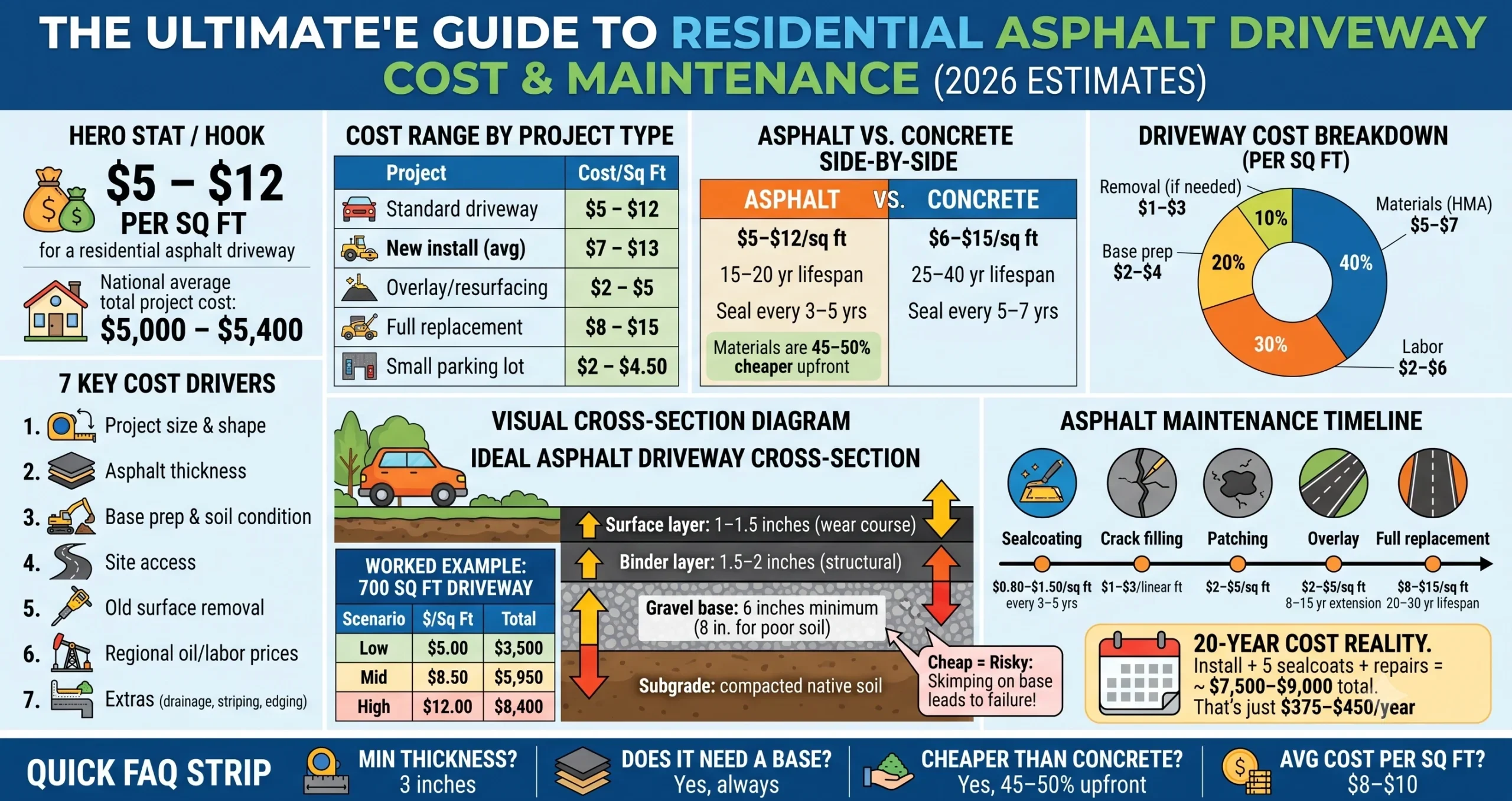
Asphalt Paving Cost Per Square Foot: Current Price Ranges (2026)
How much does asphalt paving cost per sq ft?
For a fully installed residential asphalt driveway in 2026, you should budget $5 to $12+ per square foot for materials and professional installation combined. That’s the most reliable national range based on current market data.
Here’s how that breaks down by project type:
| Project Type | Cost Per Sq Ft (Installed) | Notes |
|---|---|---|
| Standard residential driveway | $5 – $12 | Includes base prep, labor, and materials |
| New asphalt driveway (national average) | $7 – $13 | Labor and materials included |
| Asphalt overlay (resurfacing) | $2 – $5 | Placed over sound existing asphalt |
| Asphalt replacement (with demolition) | $8 – $15 | Includes old material removal |
| Asphalt parking lot (small commercial) | $2 – $4.50 | Material + labor, per sq ft |
| Recycled asphalt driveway | $4 – $9 | Lower cost, shorter lifespan |
| Porous/permeable asphalt | $7 – $15 | Allows drainage through the surface |
What is the average cost of asphalt paving per sq ft?
The national average for a complete residential installation sits around $5,000 to $5,400 total, with most homeowners spending between $3,000 and $7,500 depending on driveway size and location. On a per-square-foot basis, the midpoint for a typical 500–600 sq ft driveway runs roughly $8–$10 installed.
Material-only cost (buying hot-mix asphalt before installation) runs roughly $5 to $7 per square foot, or $100 to $200 per ton for the raw mix. Labor adds another $2 to $6 per square foot on top of that.
Regional price variation
Costs aren’t uniform across the country. Labor markets, oil prices (asphalt is a petroleum byproduct), and local aggregate availability all shift the number. The Midwest tends to come in lower — contractors in states like Wisconsin and Minnesota often quote $4–$8 per square foot installed — while coastal metro areas regularly hit the top of the range or beyond. Always get at least three local bids; national averages are starting points, not contracts.
Factors That Affect Asphalt Paving Cost Per Square Foot
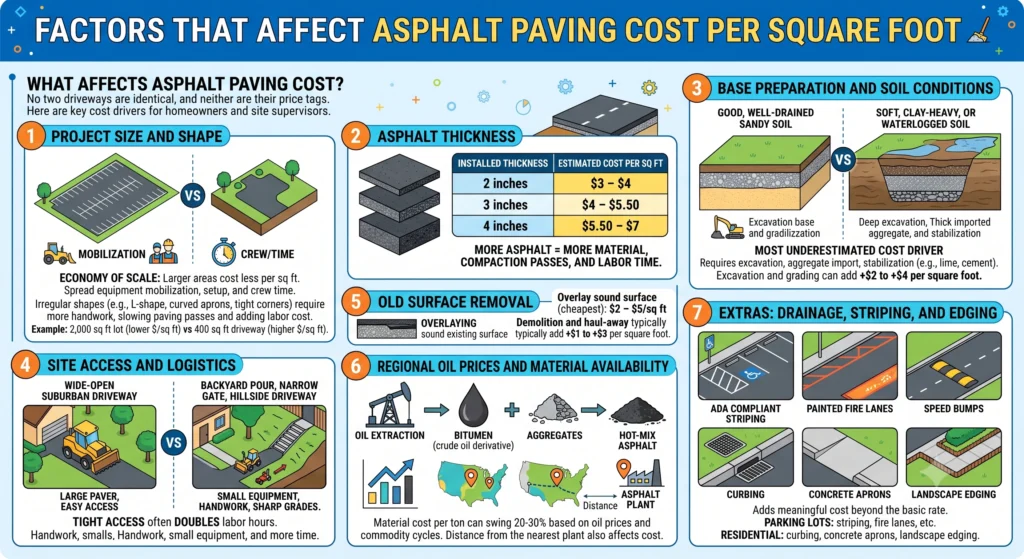
What affects asphalt paving cost?
No two driveways are identical, and neither are their price tags. Here are the key cost drivers any homeowner or site supervisor needs to understand:
1. Project size and shape
Larger paving areas cost less per square foot because equipment mobilization, setup, and crew time are spread across more surface. A 2,000 sq ft lot will almost always come in cheaper per square foot than a 400 sq ft driveway. Irregular shapes — L-shaped driveways, curved aprons, tight corners — require more handwork and slower paving passes, which adds labor cost.
2. Asphalt thickness
More asphalt equals more material, more compaction passes, and more labor time. A 2-inch surface layer costs less per square foot than a 3-inch or 4-inch application. As a rough guide:
| Installed Thickness | Estimated Cost Per Sq Ft |
|---|---|
| 2 inches | $3 – $4 |
| 3 inches | $4 – $5.50 |
| 4 inches | $5.50 – $7 |
3. Base preparation and soil conditions
This is the cost driver most homeowners underestimate. If you’re building on soft, clay-heavy, or waterlogged soil, the contractor has to excavate deeper, import and compact more aggregate, and sometimes stabilize the subgrade with lime or cement. Excavation and grading alone can add $2 to $4 per square foot to the bill. A site with good, well-drained sandy soil costs significantly less to prep than one with expansive clay.
4. Site access and logistics
A wide-open suburban driveway is easy to pave. A backyard pour behind a narrow gate or a hillside driveway with a sharp grade change? That’s handwork, smaller equipment, and more time. Tight access often doubles labor hours.
5. Old surface removal
Overlaying new asphalt over a sound, stable existing surface is the cheapest upgrade path ($2–$5/sq ft). But if the old driveway is failing, it has to come out. Demolition and haul-away typically add $1 to $3 per square foot to the project.
6. Regional oil prices and material availability
Hot-mix asphalt is manufactured from aggregates and bitumen — a crude oil derivative. When oil prices rise, asphalt prices follow. Material cost per ton can swing 20–30% based on commodity cycles and how far the nearest asphalt plant is from your site.
7. Extras: drainage, striping, and edging
A parking lot with ADA-compliant striping, painted fire lanes, speed bumps, or a catch basin system adds meaningful cost beyond the basic per-square-foot rate. For residential driveways, curbing, concrete aprons at the street edge, and landscape edging are common add-ons.
Asphalt vs. Concrete: Which Is Cheaper Per Square Foot?
Is asphalt cheaper than concrete for a driveway?
Yes, in almost every scenario, asphalt is cheaper upfront than concrete. The numbers tell a consistent story:
| Material | Installed Cost Per Sq Ft | Typical Lifespan | Maintenance Frequency |
|---|---|---|---|
| Asphalt | $5 – $12 | 15–20 years | Seal every 3–5 years |
| Concrete | $6 – $15 | 25–40 years | Seal every 5–7 years |
For a 600 sq ft driveway, asphalt installation runs roughly $3,000 to $7,200, while the same concrete driveway runs $3,600 to $9,000. On a raw install basis, asphalt materials cost approximately 45–50% less than concrete.
But the real comparison is lifecycle cost. Concrete’s longer lifespan and lower maintenance demands mean it can be cheaper over a 30-year window if you’re planning to stay in the house. Asphalt wins on upfront budget, flexibility (it handles freeze-thaw cycles better), and repairability — a damaged section of asphalt can be patched invisibly, whereas concrete repairs tend to show.
Choose asphalt when:
- You want the lowest upfront cost
- Your climate includes hard winters with freeze-thaw cycles
- You need the driveway done fast (asphalt cures for use in 24–72 hours)
- Budget is the primary driver
Choose concrete when:
- You want a 30+ year surface with minimal maintenance
- You’re in a hot climate where asphalt softening is a concern
- Aesthetics and curb appeal are high priorities (decorative finishes, exposed aggregate)
- Long-term total cost matters more than day-one price
Asphalt Driveway Cost Breakdown: Materials, Labor, and More
How much does an asphalt driveway cost per square foot?
A fully installed residential driveway breaks down roughly like this on a per-square-foot basis:
| Cost Component | Per Sq Ft Range | Notes |
|---|---|---|
| Hot-mix asphalt material | $5.00 – $7.00 | Based on $100–$200/ton |
| Labor (installation) | $2.00 – $6.00 | $40–$55/hr typical rate |
| Base preparation/grading | $2.00 – $4.00 | Excavation, gravel, compaction |
| Old surface removal (if needed) | $1.00 – $3.00 | Demo, haul-away |
| Total installed (new driveway) | $7 – $13 | Most common national range |
Worked example: 700 sq ft residential driveway
Here’s what a typical single-car-plus driveway (roughly 12′ × 58′, or about 700 square feet) looks like across low, mid, and high scenarios:
| Scenario | Cost Per Sq Ft | Total (700 sq ft) | Assumptions |
|---|---|---|---|
| Low | $5.00 | $3,500 | Good soil, minimal prep, basic mix, rural/Midwest |
| Mid | $8.50 | $5,950 | Average prep, standard 3″ HMA, suburban area |
| High | $12.00 | $8,400 | Complex prep, 4″ HMA, tight access, metro area |
These figures align with the national average install cost reported across major home improvement cost databases. Always get bids — these are planning numbers, not contractor quotes.
The simple cost formula
The core formula every estimator uses:
Total Cost = Area (sq ft) × Cost Per Sq Ft
For a 700 sq ft driveway at $8.50/sq ft, that’s 700 × $8.50 = $5,950.
Online asphalt paving cost calculators let you plug in your dimensions and a local cost per square foot to get instant estimates. They use this exact logic, sometimes extending it to tonnage so you can cross-check with supplier quotes.
Connecting to tonnage
When you’re talking to suppliers or checking material costs, you’ll work in tons rather than square feet. The practical field formula is:
Tons=12Length (ft)×Width (ft)×Thickness (in)×2000145 lbs/ft3
In simplified terms: multiply your area in square feet by the thickness in feet (e.g., 3 inches = 0.25 ft), then multiply by 145 (the standard asphalt density in lbs per cubic foot), then divide by 2,000 to get tons.
For our 700 sq ft driveway at 3 inches thick:
- 700 × 0.25 × 145 = 25,375 lbs
- 25,375 ÷ 2,000 = ≈12.7 tons of hot-mix asphalt
At $100–$200 per ton, material alone runs $1,270–$2,540 for that project. Everything else — labor, equipment, base prep — makes up the rest of the total. An online asphalt paving cost per sq ft calculator ties these two formulas together, making it easy to sanity-check contractor bids.
Asphalt Driveway Thickness and Base Requirements
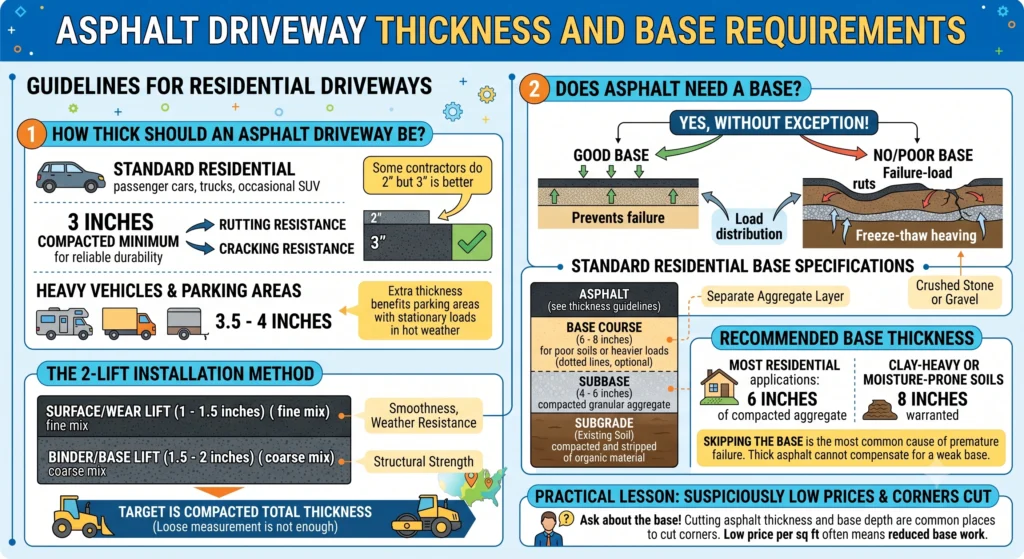
How thick should an asphalt driveway be?
For a standard residential driveway that sees passenger cars, trucks, and the occasional SUV, 3 inches of compacted hot-mix asphalt is the recommended minimum for reliable durability. Some contractors do 2-inch installs, and they’ll hold up on well-prepared soil — but 3 inches gives you meaningful resistance against rutting, cracking, and load-related deformation.
If heavy vehicles (RVs, delivery trucks, trailers) regularly use the driveway, move up to 3.5 to 4 inches. Parking areas where cars sit for extended periods benefit from the extra thickness too — stationary loads are surprisingly hard on asphalt in hot weather.
For most installations, asphalt is laid in two lifts:
- Binder/base lift: 1.5–2 inches of coarser asphalt mix, providing structural strength
- Surface/wear lift: 1–1.5 inches of finer mix, providing smoothness and weather resistance
The compacted total should meet or exceed your target thickness, not the loose-laid measurement. Always ask your contractor to quote compacted thickness — that’s the only number that matters for durability.
Does asphalt need a base?
Yes — without exception. The base is what keeps the asphalt from failing under load and from heaving with seasonal freeze-thaw cycles. A properly prepared base is more important than the thickness of the asphalt itself.
Standard residential base specifications:
- Subgrade: Existing soil, properly compacted and stripped of organic material, tree roots, and topsoil
- Subbase: 4–6 inches of compacted granular aggregate (crushed stone or gravel) for light-duty residential use
- Base course: Some contractors add a separate 6–8 inch aggregate layer for poor soils or heavier loads
The gravel base under an asphalt driveway should be 6 inches of compacted aggregate for most residential applications. In areas with clay-heavy or moisture-prone soils, 8 inches is warranted. Skipping this step or cutting it short is the single most common cause of premature driveway failure — no amount of thick asphalt compensates for a soft, unstable base.
The practical lesson: When a contractor quotes you a suspiciously low price per square foot, the first question to ask is what they’re doing with the base. Cutting asphalt thickness and base depth is where corners get cut most often.
Asphalt Driveway Maintenance and Long-Term Cost
How much does asphalt driveway maintenance cost?
A well-maintained asphalt driveway lasts 15–20 years, but that lifespan requires active maintenance. Here’s what to budget:
Sealcoating
Sealcoating is the most important recurring maintenance task. It fills surface pores, blocks UV oxidation, prevents water infiltration, and restores that fresh black appearance. Professional sealcoating runs $0.80–$1.50 per square foot, or roughly $281–$867 for a typical residential driveway, with a national average around $571. Apply it every 3–5 years — some aggressive-climate homeowners do it every 2 years.
Wait at least 6–12 months after a new installation before the first sealcoat, so the asphalt has time to cure and off-gas properly.
Crack repair
Small cracks appear over time from thermal cycling and normal use. Crack filling runs $1–$3 per linear foot, and a full driveway crack treatment typically costs $100–$400. Don’t ignore cracks — water infiltrates them, freezes in winter, and accelerates structural damage fast.
Pothole and patch repair
Isolated damage (potholes, crumbling edges, settled areas) costs $2–$5 per square foot to patch. A professional hot-patch repair runs $100–$250 per patch. Address these promptly; a $200 patch today can prevent a $5,000 replacement in five years.
How much does asphalt driveway overlay or replacement cost per square foot?
When maintenance can no longer keep up with a driveway’s deterioration, there are two paths forward:
Overlay (resurfacing): A contractor mills or cleans the existing surface, applies a tack coat for adhesion, and lays 1.5–2 inches of fresh asphalt on top. This costs $2–$5 per square foot and is appropriate when the existing driveway is structurally sound but surface-worn. An overlay extends service life 8–15 more years.
Full replacement: The old driveway comes out, the base is inspected and repaired, and a fully new asphalt section is installed. Cost runs $8–$15 per square foot, and the new surface should last 20–30 years with proper maintenance.
| Option | Cost Per Sq Ft | Lifespan Added | When to Choose |
|---|---|---|---|
| Sealcoating | $0.80 – $1.50 | Extends existing life | Every 3–5 years, preventive care |
| Crack filling | $1 – $3/linear ft | Stops damage from spreading | Any visible cracking |
| Overlay | $2 – $5 | 8–15 years | Surface worn, base intact |
| Full replacement | $8 – $15 | 20–30 years | Base failure, deep cracking, alligatoring |
The overlay vs. replacement decision comes down to the base condition. If the base is solid, an overlay is smart economics — 30–50% of the replacement cost for a significant lifespan extension. If you’re seeing “alligator cracking” (a web of interconnected cracks resembling reptile scales), that’s base failure, and an overlay will simply mirror those cracks through the new surface within a year or two. Replace it properly.
Lifecycle cost reality check
Consider a 700 sq ft driveway over 20 years:
- New installation (mid-scenario): ~$5,950
- Sealcoating × 5 applications: $1,120–$2,100 (700 sq ft × $0.80–$1.50 × 5)
- Crack fills and minor repairs: $500–$1,000 estimated over 20 years
- Total 20-year cost: roughly $7,500–$9,000
Amortized, that’s $375–$450 per year to own and maintain a quality asphalt driveway. For that cost, you have a fully functional, attractive surface that handles your daily driving needs. Skimping on base prep or delaying sealcoating are the quickest ways to double that cost.
FAQ Quick Reference
How much does asphalt paving cost per sq ft?
Installed residential driveways run $5–$12 per square foot nationally in 2026, with a typical midpoint around $8–$10.
How much does an asphalt driveway cost per square foot?
A 2026 residential driveway costs $7–$13 per square foot for a brand-new installation including labor and materials.
How thick should an asphalt driveway be?
A minimum of 3 inches of compacted hot-mix asphalt for passenger vehicles, on top of a 6-inch compacted aggregate base.
Does asphalt need a base?
Yes — always. A 6-inch compacted crushed-stone or gravel base is standard for residential driveways; poor soils require 8 inches.
What affects asphalt paving cost?
Project size, asphalt thickness, base condition and depth, regional labor/material rates, site access, and any extras like old pavement removal or drainage work.
How much does asphalt driveway maintenance cost?
Sealcoating runs $0.80–$1.50/sq ft every 3–5 years; crack repairs cost $1–$3 per linear foot; minor patching runs $2–$5/sq ft.
How much does an asphalt driveway overlay cost per square foot?
An asphalt overlay (resurfacing) costs $2–$5 per square foot — roughly 30–50% less than a full replacement.
Is asphalt cheaper than concrete for a driveway?
Yes — asphalt installs at $5–$12/sq ft vs. concrete at $6–$15/sq ft, and asphalt materials run 45–50% cheaper. Concrete may be cheaper over a 30+ year lifecycle due to lower maintenance frequency.
What is the average cost of asphalt paving per sq ft?
The national average is around $8–$10 per square foot installed for a standard residential driveway in 2026.
What is the asphalt parking lot paving cost per square foot?
Small commercial asphalt parking lots typically run $2–$4.50 per square foot for materials and labor, with larger lots benefiting from lower per-square-foot rates due to economies of scale.