
Proven Slopes for Reliable Asphalt Pavement Drainage
Practical rules of thumb for cross-fall and longitudinal grade to prevent water ponding and pavement damage
Introduction: Why Drainage Matters for Asphalt Pavements
Surface drainage — the managed removal of rainfall from a paved surface before it can accumulate, penetrate, or sit — is not a detail to be worked out after the geometry is set. It is a primary design criterion. Get it wrong and you get a pavement that fails well before its design life, regardless of how well the mix was designed or how carefully the base was compacted.
Water damages asphalt through several overlapping mechanisms. At the surface, standing water infiltrates through microcracks and air voids, weakening the adhesive bond between the asphalt binder and aggregate — a process called stripping. Once stripping begins, the mix loses cohesion, aggregate ravels loose, and the surface degrades rapidly. Beneath the surface, water that migrates through cracks or shoulders saturates the granular base (the crushed stone layer supporting the asphalt) and the subgrade (the natural or engineered soil beneath). A saturated base loses its load-carrying stiffness; traffic loads then cause deflection, accelerating fatigue cracking and eventually rutting and potholes. In freeze-thaw climates, trapped water expands when it freezes, blowing out the structure from within.
At the surface level, standing water creates immediate safety hazards. A thin water film separating a tyre from the road surface reduces skid resistance (the frictional grip that lets vehicles steer and brake). At higher speeds on shallow-ponded roads, hydroplaning occurs — the tyre rides up onto the water film and loses contact with the pavement entirely, removing steering and braking control.
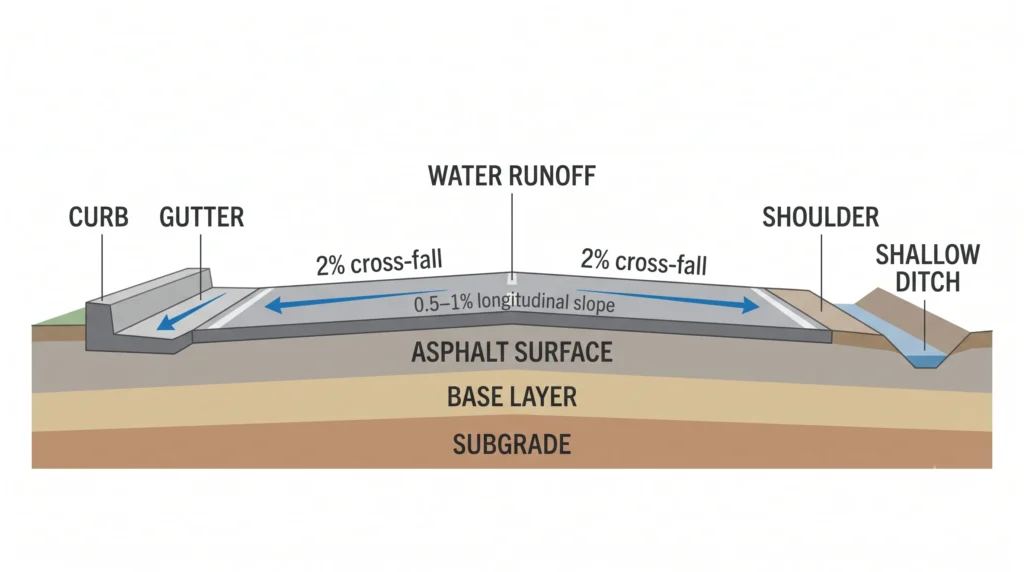
The solution is deceptively simple: provide enough slope in every direction so water always has a clear, short path to a drain, gutter, or roadside. That means getting two things right — cross-fall and longitudinal slope — and making sure neither one is flat where it matters most.
Basic Concepts: Cross-Fall, Longitudinal Slope, and Flow Paths
Cross-Fall (Transverse Slope or Camber)
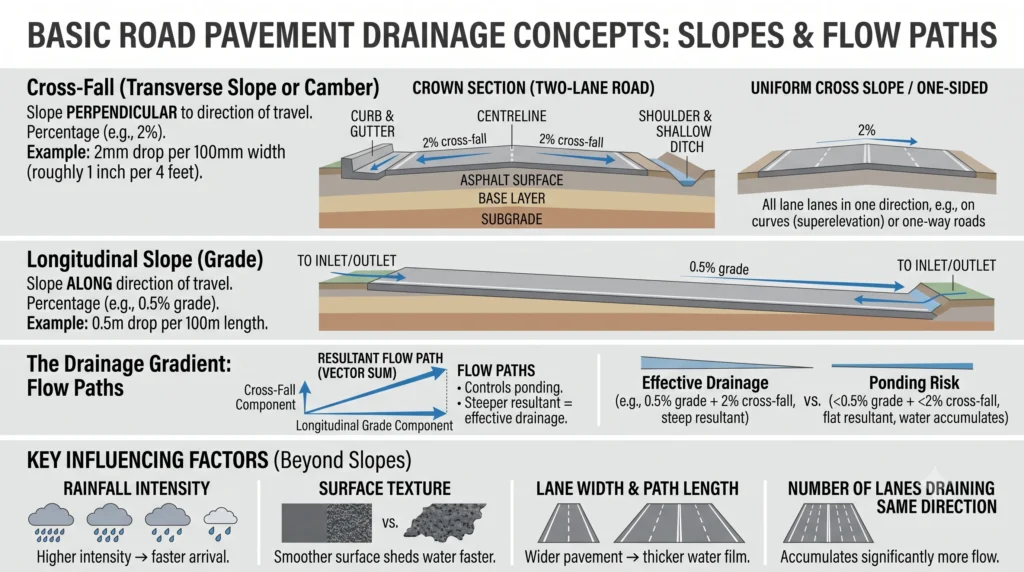
Cross-fall — also called transverse slope or camber — is the slope across the width of the pavement, measured perpendicular to the direction of travel. It is expressed as a percentage: a 2% cross-fall means the pavement surface drops 2 mm for every 100 mm of width, or roughly 1 inch per 4 feet.
On a two-lane road, the cross-fall is typically applied as a crown section: the pavement is highest at the centreline and slopes downward toward both edges. On a one-way road or a section with superelevation (the tilt applied on curves), the entire width may slope in one direction — this is called a uniform cross slope or a one-sided cross fall. On divided highways, each carriageway typically drains from its high point (near the median) toward the outer edge.
Cross-fall controls how quickly water moves laterally off the pavement surface and into the gutter, shoulder, or roadside drain.
Longitudinal Slope (Grade)
Longitudinal slope — commonly called grade or gradient — is the slope along the direction of travel. It is also expressed as a percentage. A 0.5% grade drops 0.5 m per 100 m of road length. Longitudinal slope primarily controls how fast water flows along the gutter, channel, or pavement edge toward an inlet or outlet.
The Drainage Gradient: How Cross-Fall and Grade Combine
Water on a pavement surface does not flow straight sideways or straight downhill — it flows diagonally, following a path determined by the combined drainage gradient, which is the vector sum of the cross-fall and longitudinal slope. The practical consequence: a pavement with only 0.5% longitudinal grade but a 2% cross slope will drain effectively, because the resultant flow path is still steep enough to clear the surface. But a pavement that is simultaneously near-flat in both directions is a recipe for ponding, because the resultant gradient is too low to overcome surface irregularities, construction tolerances, and minor settlements.
Key influencing factors beyond the slopes themselves include:
- Rainfall intensity — higher intensity means more water arriving faster, requiring steeper or shorter drainage paths.
- Surface texture — a smoother, denser asphalt surface sheds water faster than an open-graded or rough surface.
- Lane width and drainage path length — the wider the pavement (or the longer the uninterrupted drainage path), the thicker the water film that builds up at the outer edge.
- Number of lanes draining in the same direction — wide multi-lane carriageways accumulate significantly more flow than single-lane sections.
Effects of Poor Drainage: What Goes Wrong When Slopes Are Wrong
Bird Baths and Ponding
A bird bath is industry slang for a shallow depression — often just a few millimetres deep — where water pools after rain because the surrounding pavement is too flat to move it away. Bird baths typically form where initial cross-fall was inadequate, where compaction-induced settlement has created local low spots, or where overlay work has not restored proper grade. The name sounds harmless; the consequences are not. Water sitting in a bird bath infiltrates through surface cracks, softens the base, and accelerates deterioration of the pavement structure directly beneath the depression. Left untreated, bird baths expand into potholes.
Ponding at the bottom of sag vertical curves (the low point where a downhill grade transitions to an uphill grade) is especially problematic. At a sag, both the approaching and departing longitudinal slopes work against drainage unless an inlet is placed precisely at the low point. If an inlet is missing, undersized, or blocked, water cannot escape.
Safety Hazards
Standing water dramatically increases crash risk. Even a water film of 2–3 mm depth can reduce skid resistance to dangerous levels. At highway speeds, hydroplaning risk becomes significant when water depth reaches approximately 2.5 mm (0.1 in) over a distance of about 9 m (30 ft). Research has confirmed that hydroplaning can occur at only 50 mph (80 km/h) if the cross slope is as low as 1%. Splash and spray from vehicles on wet roads further reduces visibility, compounding the hazard.
Structural Damage
Water entering the pavement structure — whether through surface cracks, joints, or permeable shoulders — softens the granular base and subgrade. A saturated subgrade may lose 30–50% of its bearing capacity under dynamic loading. This manifests as fatigue cracking, rutting in wheelpaths, and eventually full structural failure. Moisture damage begins at the binder-aggregate interface through the mechanism of stripping, where water displaces the asphalt film from the aggregate surface. Once stripping is initiated, the pavement’s resistance to rutting and fatigue cracking drops rapidly.
Rules of Thumb for Cross-Fall (Transverse Slope)
The Baseline: 2% for Most Paved Surfaces
The near-universal starting point for asphalt pavement cross-fall is 2%. This value appears consistently in design guidance across the USA and other English-speaking countries. It is enough to move water off the surface without creating excessive side forces on vehicles, and it provides a reasonable tolerance buffer against minor construction imperfections and future settlement.
The UK Design Manual for Roads and Bridges (DMRB) uses a slightly higher standard: the minimum crossfall for motorways and trunk roads is 2.5% (expressed as 1:40). This higher value is adopted because UK roads are designed to handle rutting-induced undulations that could trap water under a flatter cross-fall.
Roads and Streets
| Road Type | Typical Cross-Fall | Notes |
|---|---|---|
| Two-lane rural highway | 2% from crown | Absolute minimum 1% |
| Urban street, ≤3 lanes | 2% from crown | Standard recommendation |
| Multilane highway, inside lanes | 2% | Near crown line |
| Multilane highway, outside lanes | 2.5–3% | Increased to reduce stormwater spread |
| UK motorway/trunk road | 2.5% minimum | DMRB standard |
| Shoulders (paved) | 2–6% (same direction as lane) | Must drain away from carriageway |
| Unpaved/gravel shoulders | 4–6% | Coarser surface requires steeper pitch |
| Low-volume rural roads | 3–5% | Varies by surface type |
On highways with three or more lanes draining in the same direction, apply a graduated cross-fall: the lanes immediately adjacent to the crown can be at 1.5–2%, with each successive outboard lane increased by 0.5–1.0%. This prevents the outer lanes — which carry the accumulated flow from all lanes inboard — from building up an unmanageable water film depth.
Parking Lots and Low-Speed Areas
For parking lots, the 2% baseline applies, but achieving it throughout the entire lot requires careful grading design. Minimum slopes for specific elements:
- Parking stalls (both longitudinal and cross-slope): 1.0% minimum, 5.0% maximum
- Drive aisles: 1.0% minimum
- Valley gutters: 0.5% minimum (some jurisdictions require 1.0%)
- ADA-accessible stalls and routes: 2.0% maximum in any direction (this governs layout)
The ADA 2% maximum cross-slope for accessible routes is the single most constraining dimension in most parking lot designs. Design the accessible areas first, establish their grade, and then work the surrounding drainage away from those areas.
Adjusting for Rainfall Intensity and Surface Texture
For areas with intense rainfall (broadly, over 40 mm/hour), increase cross-fall toward 2.5–3.0%. For very high rainfall with three or more lanes in one direction, up to 4% may be warranted. Smooth, dense-graded asphalt sheds water faster than open-textured surfaces, so the same cross-fall produces a thinner water film on a smoother surface. Conversely, open-graded or permeable asphalt (OGPA, also called porous asphalt or open-graded friction course/OGFC) allows water to drain through the wearing course rather than across it, which dramatically reduces surface water depth. Even with permeable asphalt, the underlying layers must still have adequate slope to drain the water that passes through, but hydroplaning risk at the surface is substantially reduced.
Practical minimum floor: Never design or accept asphalt pavement with a cross-fall below 1%. Cross slopes below 0.3% are considered sections with poor drainage regardless of longitudinal grade.
Rules of Thumb for Longitudinal Slope (Grade)
Curbed Streets and Gutters
With curbs present, water cannot escape laterally — it must flow along the gutter to an inlet. This makes longitudinal grade the critical drainage control. The widely adopted rules are:
- Desirable minimum: 0.5%
- Acceptable minimum: 0.3–0.4% in well-controlled situations
- Absolute minimum: 0.3% — below this, constructing accurate grade is extremely difficult, and bird baths are almost inevitable
- Cul-de-sacs and bulb-outs: 1.0% minimum
At grades below 0.5%, small errors in subgrade preparation, base placement, and paving accumulate quickly enough to create local flat zones or reversal slopes that trap water. The 0.5% target gives you a practical margin.
Uncurbed (Open-Section) Roads
Where water can escape freely off the pavement edge into a shoulder or roadside ditch, the longitudinal grade requirement relaxes significantly. A flat longitudinal grade (0%) is technically acceptable on a well-crowned uncurbed road, provided the cross-fall is adequate and the shoulders drain freely. In practice, a minimum of 0.5% is still desirable even on uncurbed sections, because it provides a margin against settlement and ensures ditch flow is maintained.
Typical Ranges for Common Situations
| Situation | Minimum Grade | Desirable Grade |
|---|---|---|
| Curbed urban street | 0.3% | 0.5% or greater |
| Uncurbed rural road | 0.0% (with good crown) | 0.5% |
| Parking lot drive aisle | 1.0% | 1.5–2.0% |
| Valley gutter / swale | 0.5% | 1.0% |
| Bridge deck (curbed) | 0.5% | 0.5% |
| Driveway | 1.0% | 1.5–2.0% |
Sag and Crest Vertical Curves
Vertical curves are the smooth parabolic transitions between two grades. At a crest curve (hill), the grade goes from positive to zero to negative; at a sag curve (valley), the opposite occurs. Both create a zone of locally flat grade at the apex.
The standard drainage criterion for vertical curves is: a minimum grade of 0.3% must be maintained within 50 ft (15 m) of the flattest point of the curve. This criterion corresponds to a parabolic K-value of 167 (K is the horizontal distance in feet per 1% change in grade). Vertical curves flatter than K = 167 require special drainage provisions — typically additional inlets, intercepting drains, or steeper cross-falls to compensate.
At sag curves on curbed roads, always place a drainage inlet at or very near the low point. A sag without an inlet is a pond waiting to form. On wide carriageways, two inlets on opposite sides of the low point are often required. At crest curves on divided highways, the superelevation rollover zone — where cross-fall transitions through zero — must be scrutinised carefully, because both cross-fall and longitudinal grade are simultaneously near-minimum at that point.
Combining Cross-Fall and Longitudinal Slope: Practical Design Rules
The Combined Drainage Gradient
The actual flow path across a pavement surface follows the resultant drainage gradient, calculated as:
SR=SC2+SG2
where SC is cross-fall and SG is longitudinal grade (both as decimal fractions). For typical values of 2% cross-fall and 0.5% grade, the resultant is approximately 2.06% — essentially the cross-fall dominates. For a near-flat pavement with 1% cross-fall and 0.3% grade, the resultant is only 1.04%, which is marginal and highly sensitive to construction tolerances.
The Golden Rule: Never Let Both Slopes Be Simultaneously Minimum
The most important combined-slope rule is: do not allow cross-fall and longitudinal grade to both be at or near their minimum value at the same location. This situation is most likely to occur at:
- Intersections and cross-street transitions, where the crown of a side street must be warped to match the through-street grade. During this transition, the cross-fall passes through zero. Ensure the longitudinal grade of the through street is sufficient to move the resulting sheet flow away.
- Superelevation rollover points, where cross-fall transitions from a normal crown (two-sided) through zero to a fully superelevated section (one-sided). At the rollover, cross-fall is momentarily zero; longitudinal grade must carry the drainage burden.
- Bottom of sag vertical curves, where longitudinal grade is at its minimum. Here the cross-fall must be adequate (2% or more) and an inlet must be present.
Wide Pavements and Hydroplaning
Wide pavements — multilane highways, wide urban boulevards, large parking lots with long uninterrupted drainage paths — accumulate significantly more surface water toward their outer edges. On a four-lane carriageway draining in one direction at 2% cross-fall, the water film at the outer edge is roughly twice as thick as on a single-lane section of the same cross-fall. On wet pavements at highway speeds, this increases hydroplaning risk materially. Address wide pavements by: increasing the outer-lane cross-fall to 2.5–3%; keeping drainage path lengths short by introducing inlets or crown lines; and considering open-graded surface courses where budget and maintenance capability allow.
Construction and Maintenance Considerations
Why Field Conditions Often Differ from Design
Even a well-designed slope can fail to perform if construction execution is poor. Common field problems include:
- Inadequate subgrade and base compaction, which leads to differential settlement after trafficking. Settlement of even 10–15 mm can reverse a designed 1% slope and create bird baths.
- Irregular paving passes — particularly at longitudinal joints between adjacent paving lanes — that create a ridge or dip rather than a smooth crossfall transition. Water ponds in the low lane.
- Improper screed setup, where the screed is not set to match the design transverse slope, or where the paving machine wanders on a poorly graded base.
- Overlays placed without correcting the underlying grade — adding 50 mm of asphalt on top of a surface with bird baths simply replicates the bird baths in the new surface unless the low spots are filled (levelling/scratch course) before the overlay.
Checking Slopes in the Field
During construction QA and post-construction inspection, slopes can be checked simply:
- String line and tape measure: run a taut string line across the cross-section at known points, measure the drop, and calculate the slope. Quick and direct for spot checks.
- Spirit or digital level/slope meter: a 1.2 m (4 ft) level with a slope attachment gives immediate cross-fall readings. Useful for rapid surveys.
- Straightedge (3 m or 4 m): lay a 3 m straightedge parallel to the flow direction to identify bird baths and low spots. Any gap greater than 6 mm (¼ in) under the straightedge is typically a reject criterion in standard specifications.
- Total station or machine control survey: for formal QA on larger projects, scan a grid of points at 25 ft (7.5 m) intervals and create a contoured surface. This identifies ponding areas definitively and documents compliance.
A common contractual tolerance is that finished pavement must be within ±12 mm (½ in) of design elevation at any point. Over a 6 m lane width, this tolerance is large enough to consume the entire 2% cross-fall design if two adjacent points fall at opposite extremes of tolerance — which underscores why a 2% design slope is a practical minimum, not a target that can be shaved.
Repair Options
When drainage defects are identified after construction or as part of maintenance:
- Milling and overlay: the correct treatment for bird baths and drainage defects. Mill out the affected area (typically 40–75 mm deep), reprofile to the correct grade, and pave. Surface patching over a bird bath without correcting the underlying profile is not acceptable practice — it replicates the problem.eng-tips+1
- Infrared repair: for small isolated depressions on otherwise sound pavement, infrared heating and recompaction can restore grade without full removal.
- Trench (linear) drains: where geometry constraints prevent achieving the desired longitudinal grade at a sag point, a linear drain (a narrow slot drain running across the pavement) can intercept water at the low point and route it to the storm drainage system.
- Inlet and outlet improvements: bird baths at gutter low points often reflect blocked or undersized inlets rather than grading defects. Clearing blockages, enlarging inlet capacity, or adding secondary inlets can solve the drainage problem without touching the pavement surface.
- Regrading approaches at parking lots: for parking lots with chronic drainage problems, a partial reconstruction to correct subgrade elevations, followed by a full overlay with correct grade established by machine control, is the most durable solution.
Design Checklists and Worked Examples
Quick Reference Checklist
Cross-Fall (Transverse Slope):
- Asphalt roads and streets: 2% standard; 1% absolute minimum; 2.5–3% in high-rainfall areas or on outer lanes of multilane carriageways
- UK motorways and trunk roads: 2.5% minimum per DMRB
- Parking stalls: 1% minimum, 5% maximum; 2% maximum for ADA-accessible stalls
- Drive aisles: 1% minimum
- Paved shoulders: 2–6% away from carriageway
- Never accept asphalt pavement below 1% cross-fall
- Sections below 0.3% cross-fall are considered poorly draining regardless of other slopes
Longitudinal Grade:
- Curbed streets: 0.5% desirable minimum; 0.3% absolute minimum
- Uncurbed roads: 0.5% desirable; 0% acceptable with good crowned section
- Parking lot gutters and valley gutters: 0.5% minimum
- Cul-de-sacs: 1% minimum
- At vertical curve apexes: 0.3% within 50 ft (15 m) of the flattest point
Combined Slope Rules:
- Never allow cross-fall and longitudinal grade to both be at or near minimum simultaneously
- At all sag low points on curbed roads: provide a drainage inlet
- For drainage path lengths exceeding 90 m (300 ft): increase cross-fall or add intermediate inlets
- Wide pavements (≥4 lanes in one direction): increase outer-lane cross-fall to 2.5–3%
Example 1: Two-Lane Rural Highway Section
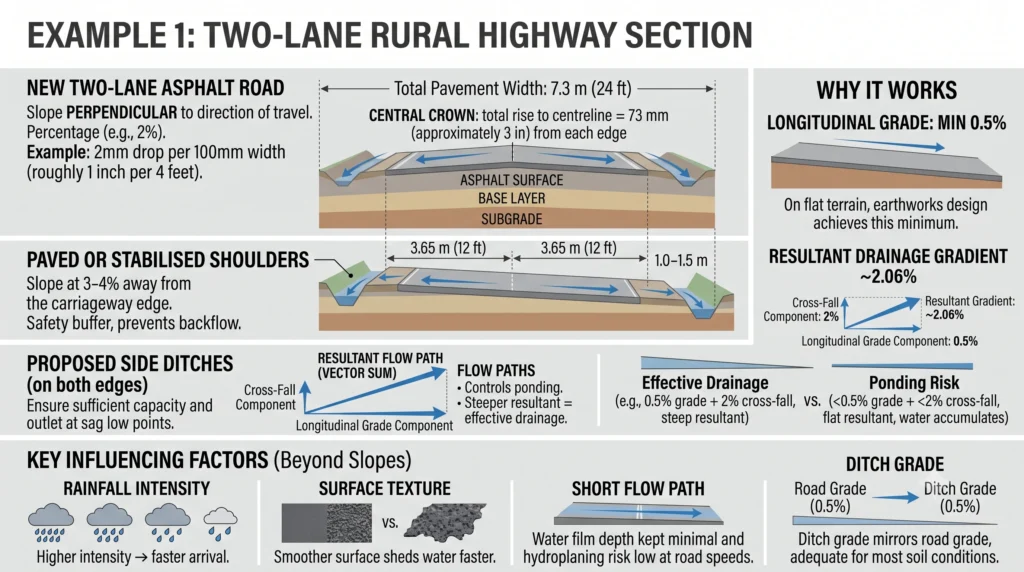
Situation: A new two-lane asphalt road, 7.3 m (24 ft) total pavement width, no curbs, rural terrain with moderate rainfall (25–40 mm/hr). Side ditches are proposed on both edges.
Recommended slopes:
- Cross-fall: 2% each side from a central crown — total rise to centreline = 73 mm (approximately 3 in) from each edge. This matches the standard AASHTO recommendation for two-lane roads.
- Longitudinal grade: Minimum 0.5% on uncurbed sections. On flat terrain, work with the earthworks design to achieve this minimum, even if it means placing the road slightly above natural ground.
- Shoulders: Pave or stabilise 1.0–1.5 m each side; slope at 3–4% away from the carriageway edge. This provides a safety buffer and prevents water from backflowing onto the carriageway.
- At sag low points: ensure side ditches have sufficient capacity and outlet. If the ditch grade mirrors the road grade, a 0.5% road grade gives a 0.5% ditch grade, which is adequate for most soil conditions.
Why it works: At 2% cross-fall and 0.5% grade, the resultant drainage gradient is approximately 2.06%. Water reaches the outer edge of each 3.65 m (12 ft) lane and enters the shoulder/ditch system in a very short flow path — under 4 m of lateral travel — keeping water film depth minimal and hydroplaning risk low at road speeds.
Example 2: Small Asphalt Parking Lot
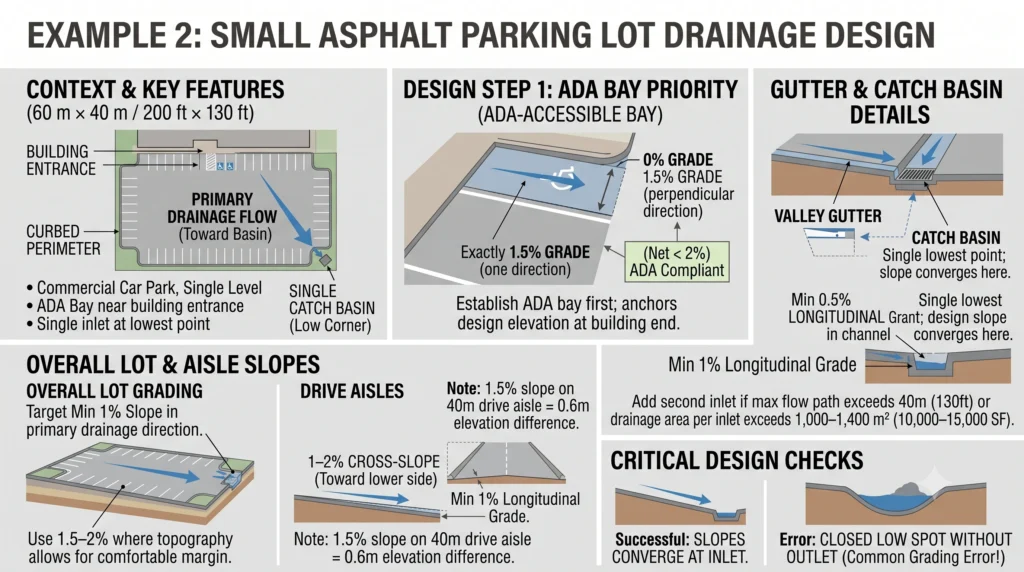
Situation: A commercial car park, 60 m × 40 m (approximately 200 ft × 130 ft), single level, with one ADA-accessible parking bay near the building entrance, curbed perimeter, single catch basin at the low corner.
Recommended slopes and layout:
- Establish the ADA-accessible bay first: grade this area at exactly 1.5% in one direction and 0% in the perpendicular direction (net < 2%), meeting ADA requirements. This anchors the design elevation at the building end.
- Remainder of the lot: grade toward the single catch basin at a minimum 1% slope in the primary drainage direction. Use 1.5–2% where topography allows for a comfortable margin.
- Drive aisles: cross-slope at 1–2% toward the lower side of the lot. Longitudinal grade of aisles should be at least 1%.
- Valley gutter at perimeter: minimum 0.5% longitudinal grade in the curb/gutter channel to move water to the catch basin.
- Catch basin location: place at the single lowest point; the design slope converges there. A second inlet should be added if the maximum flow path exceeds 40 m (130 ft) or if the drainage area per inlet exceeds approximately 1,000–1,400 m² (10,000–15,000 SF).
- Check at every low point: confirm there is no closed low spot without a drainage outlet. A low point without an inlet is the most common grading error in parking lots.
Key design note: For a 40 m drive aisle at 1.5% slope, the elevation difference end-to-end is 0.6 m (about 2 ft) — this is manageable and comfortable for parking. At only 1.0% it becomes 0.4 m. Either is acceptable, but the 1.5% provides more margin against settlement and construction tolerances.
Conclusion: Key Takeaways for Practitioners
Good drainage is not an optional refinement — it is the foundation of pavement longevity and road safety. Virtually every premature pavement failure involves water in some form, and most drainage failures trace back to one or both of two design errors: cross-fall too flat to move water laterally, or longitudinal grade too flat to move water along the channel.
The rules of thumb are straightforward enough to write on a single page:
Remember these numbers:
- 2% cross-fall for most asphalt roads and streets; 2.5% for UK trunk roads; 1% is the absolute minimum
- 0.5% longitudinal grade for curbed streets and gutters; 0.3% is the floor
- 1% minimum for parking lot elements; 2% is the comfortable target
- 0.3% within 50 ft of any vertical curve apex — if flatter, add an inlet
- Never allow cross-fall and longitudinal grade to both be near minimum at the same point
- Every low point in a curbed system needs a drainage outlet — no exceptions
Design it in, build it to grade, verify it with a level or straightedge, and repair bird baths properly when they appear. Water will always find the low spot; a well-drained pavement simply ensures that low spot has a drain.