
Explication du système de notation du concours d'orthographe du New York Times : pangrammes, génie et reine des abeilles
NYT Spelling Bee scoring is simple once you know the one exception: a valid four-letter word earns 1 point, while a valid word with five or more letters earns 1 point per letter. A pangram earns its normal length score plus a 7-point bonus.
Your points move you through nine regular ranks, from Beginner to Genius. Beyond Genius is Queen Bee, a bonus rank awarded only when you find every word on that day’s accepted answer list.
Spelling Bee scoring at a glance
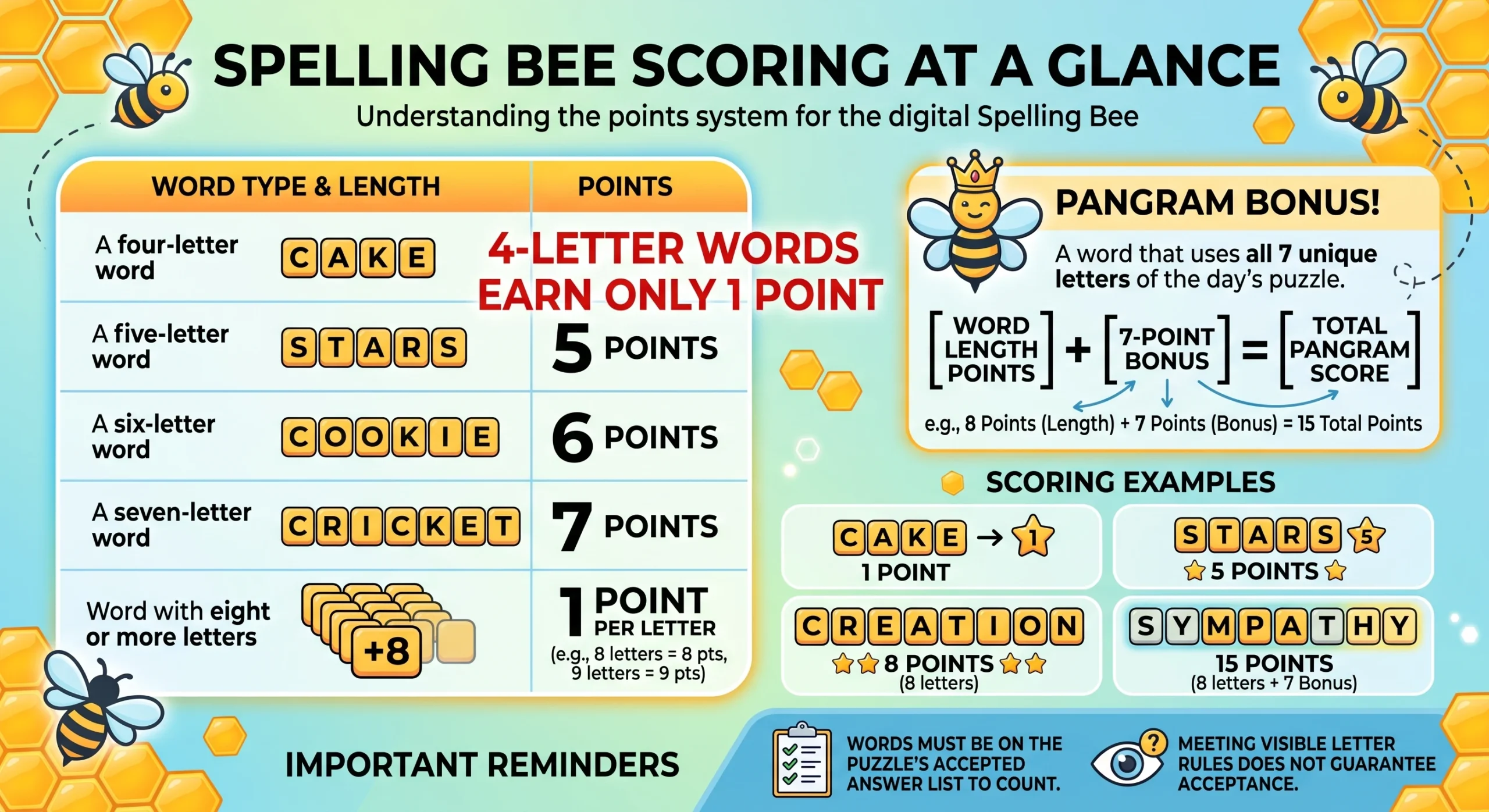
Here is the basic scoring system used in the digital NYT Spelling Bee:
| Word type | Points |
|---|---|
| Four-letter word | 1 point |
| Five-letter word | 5 points |
| Six-letter word | 6 points |
| Seven-letter word | 7 points |
| Word with eight or more letters | 1 point per letter |
| Pangram | Word length plus a 7-point bonus |
The important exception is the four-letter rule. A four-letter word does not earn 4 points; it earns only 1. Starting at five letters, the score matches the number of letters in the word.
For example:
- A four-letter word earns 1 point.
- A five-letter word earns 5 points.
- An eight-letter non-pangram earns 8 points.
- An eight-letter pangram earns 15 points: 8 points for its length and 7 bonus points.
A word counts only if it is on that puzzle’s accepted answer list. Meeting the visible letter rules does not guarantee acceptance.
What counts as a valid word?
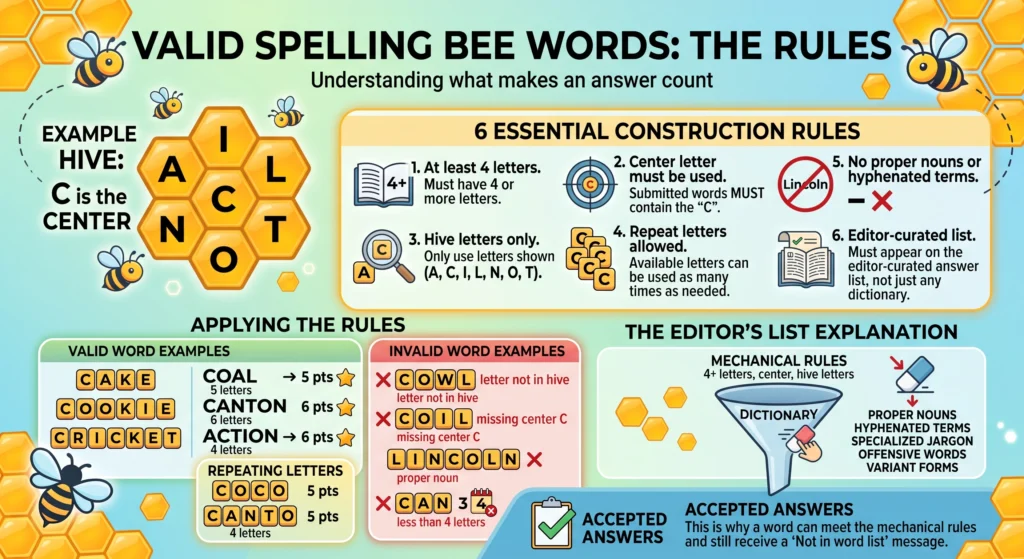
Every accepted answer must follow the puzzle’s basic construction rules:
- It must contain at least four letters.
- It must include the center letter.
- It may use only the seven letters shown in the hive.
- It may repeat available letters as many times as needed.
- It cannot be a proper noun or a hyphenated term.
- It must appear on the puzzle’s editor-curated answer list.
Suppose the hive contains the letters A, C, I, L, N, O, and T, with C in the center. Every submitted word must contain C. A word may use C or any other available letter more than once, but it cannot introduce a letter outside the hive.
The game does not accept every word found in every dictionary. Highly obscure terms, specialized jargon, offensive words, proper nouns, and some variant forms may be left out. This is why a word can satisfy the mechanical rules and still receive a “Not in word list” message.
How pangram scoring works
A pangram is an accepted word that uses all seven hive letters at least once. It must still contain the center letter, although that happens automatically because it uses every letter in the hive.
Every pangram receives 7 extra points in addition to its normal length score:
| Pangram length | Length points | Bonus | Total score |
|---|---|---|---|
| 7 letters | 7 | 7 | 14 points |
| 8 letters | 8 | 7 | 15 points |
| 9 letters | 9 | 7 | 16 points |
| 10 letters | 10 | 7 | 17 points |
A common mistake is to say that a pangram is worth 7 points. It is more accurate to say that a pangram earns 7 extra points. Its total value is its number of letters plus the bonus.
Every daily puzzle contains at least one pangram, and some contain more than one. A pangram may repeat letters; it only needs to include each of the seven available letters at least once.
What is a perfect pangram?
A perfect pangram is a seven-letter word that uses each hive letter exactly once. Because it has seven letters and qualifies for the pangram bonus, it earns 14 points.
A longer pangram is not a perfect pangram because at least one letter must repeat. It still receives the same 7-point bonus.
All Spelling Bee ranks
As your score rises, the game moves you through a series of ranks. The nine regular ranks are:
- Beginner
- Good Start
- Moving Up
- Good
- Solid
- Nice
- Great
- Amazing
- Genius
The point targets change daily because each puzzle has a different collection of accepted words and a different maximum score. The ranks are based on portions of that day’s total available points rather than permanent point totals.
| Rang | Approximate share of total points |
|---|---|
| Beginner | 0% |
| Good Start | 2% |
| Moving Up | 5% |
| Good | 8% |
| Solid | 15% |
| Nice | 25% |
| Great | 40% |
| Amazing | 50% |
| Genius | 70% |
| Queen Bee | 100% |
The game converts these percentages into whole-number targets. For the exact score required on a particular day, use the rank target displayed inside that puzzle.
How many points do you need for Genius?
Genius requires about 70% of the puzzle’s total available points. There is no universal Genius score because the maximum changes from one puzzle to the next.
If a puzzle contains 200 total points, the Genius target is about 140 points. If another puzzle contains 100 total points, its Genius target is about 70 points. The exact whole-number target shown in the game is the number that matters.
Reaching Genius does not require finding every accepted answer. It means you have collected enough points to cross the Genius threshold. Depending on the words you find, you may still be missing many short answers or a smaller number of valuable long words.
Can you reach Genius without a pangram?
Yes. Genius is based on your point total, not on whether you have found a pangram. If the puzzle offers enough points from non-pangram words, you can reach the threshold without one.
A pangram is still one of the fastest ways to raise your score because of its 7-point bonus. Finding a seven-letter pangram, for example, adds 14 points at once.
What Queen Bee means
Queen Bee is the highest possible achievement in a puzzle. You earn it by finding every word on that day’s accepted answer list and therefore collecting every available point.
This makes Queen Bee fundamentally different from Genius:
| Genius | Queen Bee |
|---|---|
| Requires about 70% of the total points | Requires 100% of the total points |
| Allows accepted words to remain unfound | Requires every accepted word |
| Is the highest regular rank | Is a hidden bonus or “Easter egg” rank |
| Can be reached without a pangram in some puzzles | Requires all pangrams because every answer must be found |
A player can be close to the maximum score without being one word away from Queen Bee. Four-letter words earn only 1 point each, so a small gap in points may represent several missing words.
For example, being 5 points short could mean you are missing one five-letter word. It could also mean you are missing five four-letter words. Your score alone does not reveal the number of answers you still need.
A complete scoring example
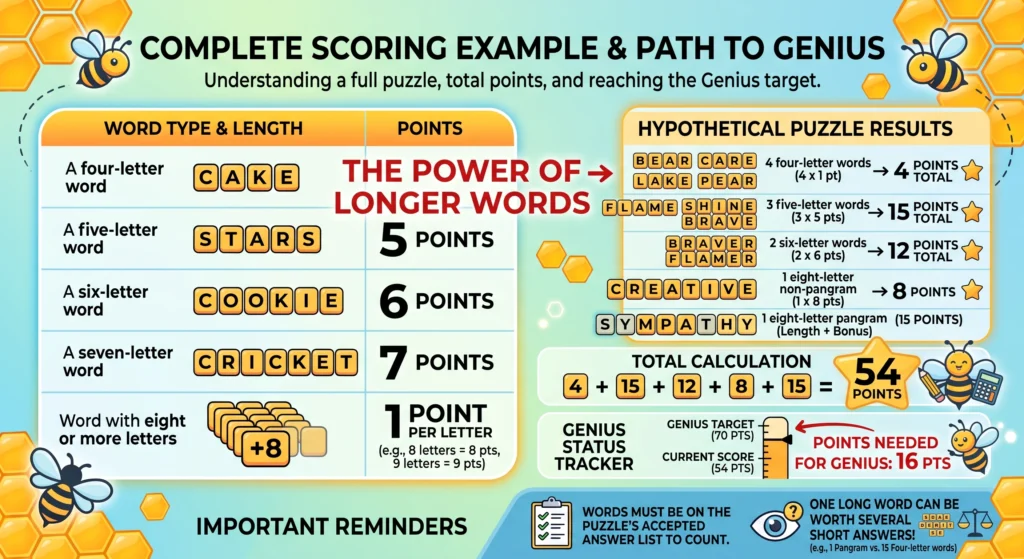
Consider a hypothetical puzzle in which you find the following:
- Four four-letter words: 4 points total.
- Three five-letter words: 15 points total.
- Two six-letter words: 12 points total.
- One eight-letter non-pangram: 8 points.
- One eight-letter pangram: 15 points.
Your total would be 54 points:
4 + 15 + 12 + 8 + 15 = 54
The pangram contributes 15 points because its eight letters earn 8 base points and its pangram status adds another 7. If that hypothetical puzzle’s Genius target were 70 points, you would need 16 more points to reach Genius.
This example also shows why longer words matter. Four-letter answers help fill out the list, but one long word can be worth as much as several short answers.
Why a word may not be accepted
Few things are more frustrating than entering a real word and seeing it rejected. Usually, one of the following explains what happened.
It does not contain the center letter
Every answer must use the center letter at least once. A word made entirely from the six outer letters is invalid, regardless of its length.
It uses an unavailable letter
You may reuse a hive letter, but you cannot introduce a letter that is not displayed. Check the word letter by letter rather than relying on how it sounds.
It is too short
Three-letter words and shorter entries never score. The minimum length is four letters.
It is not on the curated answer list
The answer list is edited rather than copied directly from one unrestricted dictionary. A legitimate but obscure, technical, regional, or unusual word may not be included.
It is a proper noun or hyphenated expression
Names and other proper nouns are excluded. Words that require a hyphen are also not accepted as hyphenated entries.
A related form is accepted, but this form is not
Finding one form of a word does not guarantee that every inflection or derivative will count. Try plausible plurals, participles, comparative forms, and related words when the necessary letters are available, but remember that each form must be included separately in the accepted list.
How to score more points
Scoring efficiently is not just about finding the greatest number of words. Word length and pangram bonuses make some answers much more valuable than others.
Search for the pangram early
Start by looking for a word that can connect all seven letters. Check common beginnings and endings, then consider whether letters can repeat. Even when the full pangram does not appear immediately, its fragments can reveal shorter related words.
Build word families
After finding a word, see whether the same letters can create a longer form. Depending on the hive, a root word may lead to a past-tense form, a word ending in “-ing,” an agent noun, or a compound word.
Do not assume that every grammatical variation is accepted, but testing reasonable extensions is an efficient way to uncover longer answers.
Use the center letter as an anchor
Instead of scanning all seven letters equally, build around the required center letter. Try it at the beginning, in the middle, and near the end of a word. This avoids spending time on words that can never qualify.
Remember repeated letters
The hive shows unique letters, not a limit on how often each one can appear. Repeating a vowel or consonant can unlock words that are easy to miss when you treat the puzzle like a standard anagram.
Look beyond four-letter words
Four-letter answers are useful, especially when pursuing Queen Bee, but each earns only 1 point. Five-letter and longer words raise your score much faster because they earn their full length in points.
Shuffle the hive
Changing the positions of the six outer letters can make familiar combinations easier to notice. The center letter remains required, so keep returning your attention to it after each shuffle.
Take a short break
Repeatedly staring at the same arrangement can make obvious words effectively invisible. Returning after a few minutes often helps you see prefixes, suffixes, double letters, and compounds that you overlooked.
Use hints without spoiling everything
If you are stuck, begin with the least revealing form of help. A word-count grid, a list of starting-letter pairs, or a breakdown by word length can point toward a gap without showing the answer.
When you want more direct help, the Hippo Tools Spelling Bee Solver can generate candidate words from seven hive letters while enforcing the center-letter and minimum-length rules. Standard mode focuses on common, likely answers, while Expanded mode offers a broader list for harder searches.
No independent solver can guarantee a perfect match with an editor-curated daily answer list. Treat suggested words as possibilities to try in the puzzle, not as proof that every suggestion will be accepted or that no other accepted answer exists.
Frequently asked questions
Is a four-letter word worth 4 points?
No. Every accepted four-letter word earns 1 point. The one-point-per-letter rule begins with five-letter words.
How many points is a five-letter word worth?
An accepted five-letter word earns 5 points, provided it includes the center letter and uses only letters from the hive.
How many points is a pangram worth?
A pangram earns 1 point per letter plus a 7-point bonus. A seven-letter pangram earns 14 points, an eight-letter pangram earns 15, and a nine-letter pangram earns 16.
Does every puzzle have a pangram?
Yes. Every digital NYT Spelling Bee puzzle includes at least one pangram, and a puzzle can include multiple pangrams.
Can letters be repeated?
Yes. Any letter shown in the hive can be used more than once. The word must still contain the center letter and cannot use letters outside the hive.
Can a pangram repeat letters?
Yes. A pangram must use all seven hive letters at least once, but it may repeat some of them. Only a perfect pangram uses each letter exactly once.
Can you reach Genius without finding every word?
Yes. Genius requires about 70% of the available points, so accepted words can remain unfound. Queen Bee requires every accepted answer.
Can you reach Genius without a pangram?
Yes, when the non-pangram answers provide enough points to reach the Genius threshold. Finding a pangram is helpful but is not a formal requirement for Genius.
Is Queen Bee the same as Genius?
No. Genius is the highest regular rank and requires about 70% of the available points. Queen Bee is a bonus rank that requires every accepted word and 100% of the available points.
Why does the Genius score change every day?
Each puzzle has a different answer list and maximum score. Because the Genius target is tied to the day’s available points, the required score changes with the puzzle.
Does every dictionary word count?
No. The puzzle uses an editor-curated answer list. A word can satisfy the letter rules and appear in a dictionary but still be excluded from that day’s accepted answers.
The scoring rule to remember
For quick calculations, remember three facts: four-letter words earn 1 point, words of five or more letters earn 1 point per letter, and pangrams receive 7 additional points. Genius is reached at about 70% of the day’s available score, while Queen Bee requires every accepted word and every available point.