
Smart 5-Letter Wordle Patterns: ER, ASK, ING & More
Introduction
Every green and yellow tile in Wordle is information — and the fastest solvers treat that information as a pattern, not just a letter. Knowing that your answer ends in ER, starts with ASK, or has an A locked in the middle position doesn’t just narrow the list; it can cut hundreds of possibilities down to a handful in a single mental step.
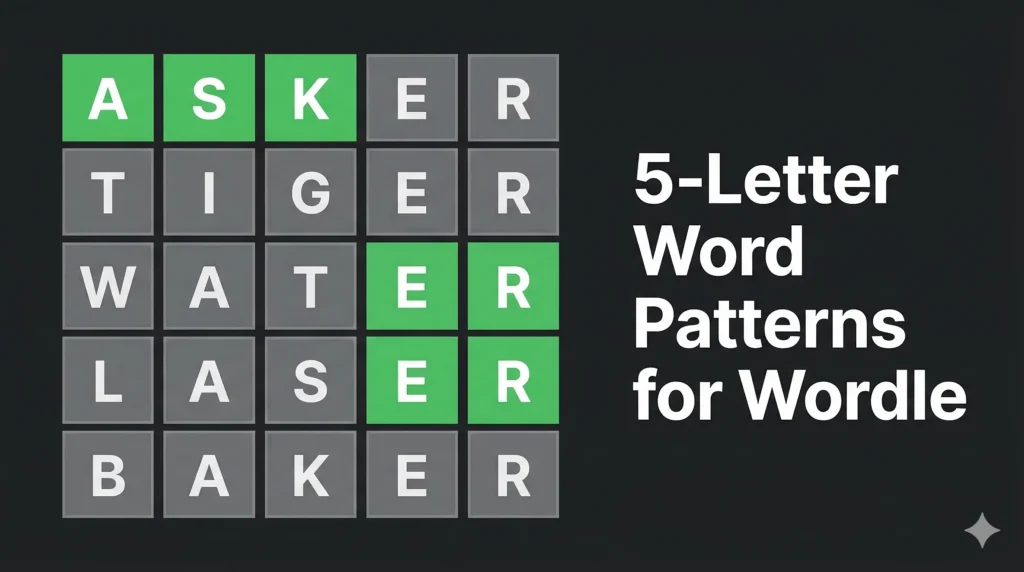
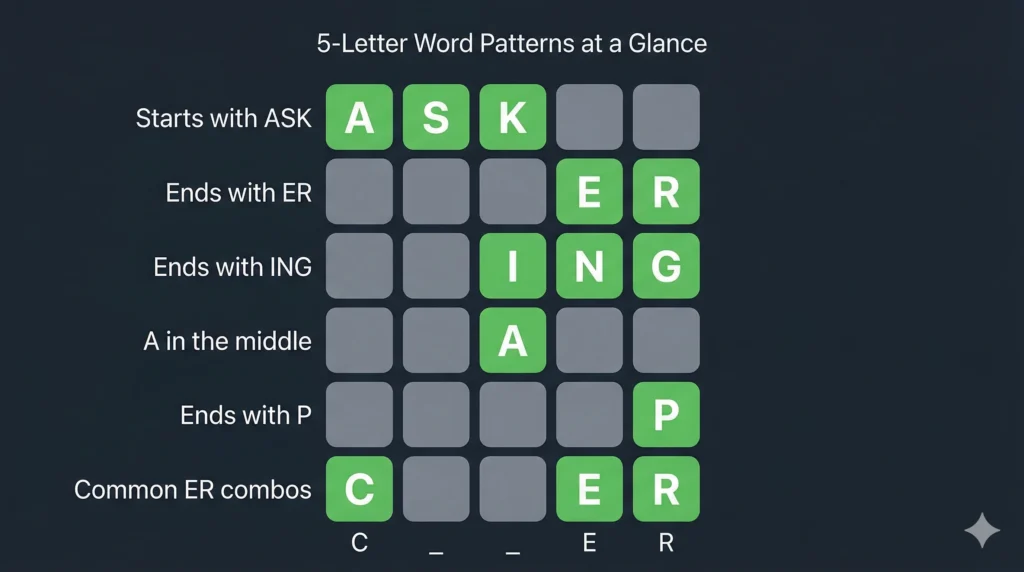
This guide covers the most useful 5-letter word patterns for Wordle and similar word games: words starting with ASK, words ending in ER (the single richest ending in the English word list), and other high-value endings like ING, ST, P, and LY. It also covers combo patterns (e.g., starts with C and ends in ER) and middle-letter locks. Every section includes word lists, tables, and concrete strategy tips so you can apply patterns the moment you sit down to play.
How 5-Letter Patterns Help You Win in Wordle
A pattern in Wordle terms is any constraint you’ve confirmed about the answer’s structure — a fixed letter at a specific position, a confirmed ending, or a known starting pair. Patterns are powerful because Wordle’s word list is finite: locking in even one positional constraint can eliminate 60–80% of remaining candidates.
Example 1: You know the last two letters are E and R (positions 4 and 5). You’ve just filtered the entire answer pool to words ending in ER — roughly 200–300 common words rather than 2,000+. Play a high-coverage guess that tests common letters in positions 1–3 (like UPPER, TIGER, or BOXER) and you’ll often solve in the next one or two turns.
Example 2: You’ve confirmed A, S, and K in positions 1, 2, and 3 respectively. The pattern is ASK_ _. There are only a handful of common 5-letter words that fit — the pattern essentially solves itself.
The practical habit to build: after each guess, translate your colored tiles directly into positional constraints. Green = locked position. Yellow = confirmed letter, wrong position. Then ask: what pattern does this create, and what words fit it?
5-Letter Words Starting With ASK
Why ASK__ Is a Powerful Pattern
“ASK” as a starting cluster is notable precisely because it’s small. There are very few common 5-letter words that begin with ASK, which means if your tiles confirm A-S-K in the first three positions, you’re essentially at the finish line. It’s also a useful early guess cluster: A, S, and K are moderately common Wordle letters that can generate useful yellow/green information across the board.
The ASK__ Word List
| Word | Type | Notes |
|---|---|---|
| ASKED | Verb (past) | Past tense of “ask” — very common, high Wordle probability |
| ASKER | Noun | One who asks; less common but valid |
| ASKEW | Adjective | Crooked, off-center — a Wordle favorite due to rare letters |
ASKEW is the standout here. It contains W and the unusual vowel arrangement E-W at the end, making it a surprisingly effective early guess for testing W and confirming the ASK cluster simultaneously.
Strategy: When to Play ASK__ Words
- Play ASKED when you want to confirm common letters (A, S, K, E, D) in early rounds — it’s a high-information opener.
- Play ASKEW if you suspect W is in the answer or want to test an unusual vowel-consonant ending.
- If you land on ASK_ _ as a confirmed pattern mid-game, the short list above means you can often guess the answer outright rather than needing another elimination round.
5-Letter Words Ending in ER
Why __ER Is the Most Useful Wordle Ending
The ER ending is everywhere in English for three structural reasons: agent nouns (BAKER, MAKER, BOXER — a person or thing that does something), comparative adjectives (LATER, WIDER, OUTER), and common everyday nouns and verbs that just happen to end in ER (WATER, TIGER, ORDER, LASER). This makes __ER one of the most statistically likely endings in any Wordle puzzle, and knowing common ER words cold is a genuine competitive advantage.
Common Everyday ER Words
These are high-frequency words that appear regularly in Wordle answer lists:
| Word | Type | Notes |
|---|---|---|
| WATER | Noun | Extremely common; tests W, A, T |
| TIGER | Noun | Tests T, I, G |
| LASER | Noun | Tests L, A, S |
| ORDER | Noun/Verb | Tests O, R, D |
| RIVER | Noun | Tests R, I, V |
| INNER | Adjective | Double N — useful for testing N |
| UPPER | Adjective | Double P — useful for testing P and U |
| ANGER | Noun/Verb | Tests A, N, G |
| UNDER | Preposition | Tests U, N, D |
| OFFER | Verb/Noun | Double F — rare letter test |
Sub-Patterns Within __ER
Breaking __ER into finer sub-patterns makes guessing even more targeted:
A_ER words (A in position 1, ER ending): AMBER, AFTER, ADDER, ABLER
_A_ER words (A in position 2, ER ending): BAKER, LASER, MAKER, PAPER, LATER, WATER, RAVEN (note: not all fit — filter carefully)
_ _TER words (T in position 3, ER ending): WATER, OUTER, INTER, UTTER, AFTER, LITER, MITER, VOTER, ENTER, OUTER, CATER, LATER, BITER
The _ _TER sub-pattern is especially rich and worth memorizing as a cluster, since T + ER at the end is one of the most common 5-letter structures in English.
Strategy Table: __ER Patterns in Wordle
| Pattern | Example Words | When to Use |
|---|---|---|
| __ER (any) | TIGER, BOXER, ORDER | When positions 4–5 confirmed as ER |
| A__ER | AMBER, AFTER | When position 1 is also confirmed A |
| _A_ER | BAKER, LASER, WATER | When position 2 confirmed as A |
| __TER | WATER, OUTER, ENTER | When position 3 confirmed as T |
| _O_ER | BOXER, VOTER, COVER | When position 2 confirmed as O |
| _I_ER | TIGER, VIPER, RIVER | When position 2 confirmed as I |
Wordle-Specific ER Strategy Tips
- When you know __ER but nothing else: Play a word that hits common letters in positions 1–3. TIGER (T, I, G) and BOXER (B, O, X) are good probes because they test less-common consonants that quickly confirm or eliminate whole letter families.
- When you know _A_ER: You’re probably looking at BAKER, LASER, MAKER, PAPER, WATER, CATER, or LATER. These share A and ER — your next guess should focus on testing B vs. L vs. M vs. P vs. W vs. C in position 1 and the middle consonant.
- When you know _ _TER: WATER, OUTER, ENTER, INTER, VOTER, LITER, and MITER are your main candidates. The differentiating letters are in positions 1–2, so a guess probing W/O/E/I/V/L/M at once (if possible) is ideal.
Other High-Value Endings: ING, ST, P, LY
5-Letter Words Ending in ING
Why ING matters: Present participle verb forms are heavily represented in English and Wordle. Confirming G in position 5 and N in position 4 immediately signals an ING ending, which is one of the most recognizable grammatical patterns.
| Word | Notes |
|---|---|
| BRING | Tests B, R — good early guess |
| FLING | Tests F, L |
| CLING | Tests C, L |
| STING | Tests S, T |
| SWING | Tests S, W |
| THING | Tests T, H |
| TYING | Irregular; tests Y |
| OHING | Rare — avoid unless desperate |
Strategy tip: If you’ve confirmed ING (positions 3–5) with the pattern _ _ ING, your primary unknowns are positions 1 and 2. Play a guess that exhausts common two-letter starts: BL, CL, FL, ST, SW, TH are the highest-yield pairs to probe.
If ING falls in positions 3–5 (i.e., _ _ ING), note that many words follow the pattern consonant-consonant-ING: BRING, CLING, FLING, SLING, STING, SWING, THING, TYING, DYING, LYING.
5-Letter Words Ending in ST
Why ST matters: ST endings cover a wide grammatical range — superlatives (WORST, LEAST), common nouns (CHEST, ROOST, CRUST), and past tenses (BURST, HOIST). It’s one of the more common two-letter endings in 5-letter English words.
| Word | Notes |
|---|---|
| CHEST | Tests C, H, E |
| CRUST | Tests C, R, U |
| BURST | Tests B, U, R |
| LEAST | Tests L, E, A |
| WORST | Tests W, O, R |
| ROOST | Tests R, O — double O |
| TWIST | Tests T, W, I |
| GHOST | Tests G, H, O |
| BOOST | Double O — tests B |
Strategy tip: When you’ve confirmed ST at the end (positions 4–5), prioritize guesses that cover the vowels in positions 2–3 (E, U, O, A are the most common mid-letters before ST). Words like CHEST, CRUST, and LEAST each probe a different vowel, letting you triangulate quickly.
5-Letter Words Ending in P
Why P matters: Final P is less common than ER or ST, but when it appears, the pool of candidates is small — which is an advantage. Confirming P in position 5 cuts your options dramatically.
| Word | Notes |
|---|---|
| TROOP | Double O — tests T, R |
| DROOP | Tests D, R |
| SCOOP | Tests S, C |
| STOOP | Tests S, T |
| EQUIP | Tests Q, U, I — rare letters |
| CLASP | Tests C, L, A, S |
| CRIMP | Tests C, R, I, M |
| STOMP | Tests S, T, O, M |
| SWAMP | Tests S, W, A, M |
Strategy tip: 5-letter words ending in P cluster into two groups — those ending in OOP (TROOP, DROOP, SCOOP, STOOP) and those ending in a consonant cluster before P (CLASP, CRIMP, STOMP). If you’ve confirmed P and an O nearby, the OOP cluster is your best bet. Otherwise, think about consonant-heavy patterns.
5-Letter Words Ending in LY
Why LY matters: LY endings are almost exclusively adverbs, which means Wordle uses them selectively — but they do appear. Confirming LY at the end gives you a strong grammatical filter.
| Word | Notes |
|---|---|
| EARLY | Tests E, A, R |
| OVERLY | (6 letters — not valid) |
| BADLY | Tests B, A, D |
| TRULY | Tests T, R, U |
| WRYLY | Double Y — rare |
| ODDLY | Double D — tests O |
| APTLY | Tests A, P, T |
| DIMLY | Tests D, I, M |
| DRYLY | Double Y, tests D, R |
| EVENLY | (6 letters — not valid) |
Strategy tip: 5-letter LY words are genuinely limited. Once you’ve confirmed LY, your realistic candidate list is short enough to run through mentally: EARLY, BADLY, TRULY, APTLY, DIMLY, ODDLY, WRYLY, DRYLY, SURLY, BURLY, CURLY, KNEEL (not LY). Focus your remaining guess on the first three letters.
Combo Patterns: Starting With X and Ending in ER
Once Wordle feedback gives you both the first letter and an ER ending, you’re working with an extremely tight pattern. These combo lists are short enough to memorize or scan in seconds.
Starting With O, Ending in ER
| Word | Type |
|---|---|
| ORDER | Noun/Verb |
| OLDER | Adjective |
| OFFER | Verb/Noun |
| OUTER | Adjective |
| OGLER | Noun (rare) |
| OTTER | Noun |
| OATER | Noun (informal) |
Practical takeaway: O + ER words are dominated by ORDER, OLDER, OFFER, OUTER, and OTTER. If you confirm O in position 1 and ER at the end, try a guess that tests R/L/F/T/T in position 2–3 to differentiate.
Starting With C, Ending in ER
| Word | Type |
|---|---|
| COVER | Verb/Noun |
| CIDER | Noun |
| CAPER | Noun/Verb |
| CATER | Verb |
| CYBER | Adjective |
| CLEAR | (ends in AR, not ER) |
| COWER | Verb |
| CURER | Noun |
| CRIER | Noun |
Key C+ER words to know: COVER, CIDER, CAPER, CATER, COWER, CRIER. The distinguishing factor is usually the vowel in position 2 (O, I, A) — identify that and the word often becomes obvious.
Starting With D, T, and U — Ending in ER
| Start | Words |
|---|---|
| D | DINER, DIVER, DRIER, DRYER, DEFER, DETER, DOVER (proper — avoid), DOSER |
| T | TIGER, TONER, TUNER, TAPER, TIMER, TIBER (proper), TOWER, TAKER |
| U | UNDER, UPPER, USHER, UDDER |
Strategy note: T + ER words are particularly rich (TIGER, TOWER, TAPER, TIMER, TONER, TUNER) because T is a high-frequency Wordle letter. If you confirm T in position 1 and ER at the end, you have roughly 8–10 realistic candidates — play a guess that probes the vowel in position 2 (I vs. O vs. A vs. U) to cut the list in half.
Middle-Letter / Contains Patterns: “A in the Middle”
How Middle-Letter Locks Work
A confirmed letter in position 3 (the middle) is one of the highest-value constraints Wordle can give you, because position 3 is shared by the largest number of overlapping word patterns. “A in the middle” — i.e., _ _ A _ _ — narrows the list significantly, especially when combined with a confirmed ending.
5-Letter Words With A in the Middle (Position 3)
Common examples across different endings:
| Pattern | Words |
|---|---|
| _ _ A _ _ (A in pos. 3) | BLANK, CLAMP, GLASS, GRACE, PLANT, PLATE, SLACK, SNACK, SPARK, STAGE, SWAMP, BRACE |
| _ _ A _ ER (A pos. 3 + ER end) | BLAZER, BRACER, GRADER, SHAKER, SLAVER, STAGER (check validity) |
| _ _ A _ ING (A pos. 3 + ING) | BLAZING, BRACING — (most are 7 letters; 5-letter options limited) |
Key insight: When A is confirmed in position 3 and you know the ending, your pool often drops to fewer than 20 words. For example, A in position 3 plus ER in positions 4–5 gives you words like MAKER, BAKER, LASER, RAVER, WAGER, CAPER, TAPER, GAMER, PAGER — all following the pattern _ A _ E R. From there, a single guess testing M/B/L/R/W/C/T in position 1 resolves the answer.
Stacking Patterns
The real power comes when multiple pattern constraints combine:
- A in position 2 + ER ending → BAKER, LASER, WATER, PAPER, LATER, MAKER, CAPER, RAVER
- A in position 3 + ST ending → BEAST, FEAST, LEAST, TOAST, ROAST, COAST, BOAST, YEAST
- I in position 2 + ER ending → TIGER, RIDER, DIVER, VIPER, MINER, RIVER, BIKER, LINER
Each constraint you add from Wordle feedback narrows the field multiplicatively, not additively. Two constraints together are far more powerful than either alone.
Quick-Reference Tables / Cheat Sheet
Table 1: ASK__ Words
| Pattern | Words | When to Use |
|---|---|---|
| ASK_ _ | ASKED, ASKER, ASKEW | When A-S-K confirmed in positions 1-2-3 |
Table 2: Core __ER Patterns
| Pattern | Example Words | When to Use |
|---|---|---|
| _ _ _ ER | TIGER, BOXER, ORDER, WATER | Positions 4–5 confirmed ER |
| A _ _ ER | AFTER, AMBER | Position 1 = A, positions 4–5 = ER |
| _ A _ ER | BAKER, LASER, WATER, MAKER | Position 2 = A, positions 4–5 = ER |
| _ _ TER | WATER, ENTER, OUTER, VOTER | Position 3 = T, positions 4–5 = ER |
| _ O _ ER | ORDER, BOXER, VOTER, COVER | Position 2 = O, positions 4–5 = ER |
| C _ _ ER | COVER, CIDER, CAPER, COWER | Position 1 = C, positions 4–5 = ER |
| O _ _ ER | ORDER, OLDER, OFFER, OUTER | Position 1 = O, positions 4–5 = ER |
Table 3: Bonus Pattern Reference
| Pattern | Example Words | When to Use |
|---|---|---|
| _ _ ING | BRING, CLING, STING, THING | Positions 3–5 confirmed as ING |
| _ _ _ ST | CHEST, CRUST, LEAST, WORST | Positions 4–5 confirmed as ST |
| _ _ _ _ P | TROOP, CLASP, STOMP, SWAMP | Position 5 confirmed as P |
| _ _ _ LY | EARLY, BADLY, TRULY, APTLY | Positions 4–5 confirmed as LY |
| _ A _ _ _ | BLANK, SPARK, PLATE, STAGE | Position 2 confirmed as A |
| _ _ A _ _ | GRACE, PLANT, GLASS, SWAMP | Position 3 confirmed as A |
FAQs for Wordle Pattern Questions
How many 5-letter words end in ER? There are roughly 200–400 common 5-letter words ending in ER in standard English dictionaries, and a smaller subset of around 150–200 that fall within Wordle’s answer list. It’s one of the most frequent endings in the game.
What are some good 5-letter words that end in ER for Wordle? Strong picks include TIGER, WATER, BOXER, LASER, BAKER, ORDER, UNDER, OFFER, and INNER. These cover a wide range of common letters and are all valid Wordle answers.
What are 5-letter words starting with ASK? The main valid options are ASKED, ASKER, and ASKEW. ASKEW is the most Wordle-notable because of its unusual letter combination (W, E, W placement).
How do I use letter patterns to narrow down Wordle answers? Translate your green tiles into fixed positions and your yellow tiles into confirmed-but-misplaced letters, then think in terms of endings and beginnings. Knowing you have __ER, for example, immediately filters hundreds of words — then use your next guess to probe the most likely letters for positions 1–3.
What’s the most common 5-letter word ending in Wordle? ER and ED are statistically the most common 5-letter endings in English, with ER appearing slightly more often in Wordle-style answer lists. ING and ST follow as the next most frequent.
When should I guess a word ending in ING? Guess an ING-ending word when you’ve confirmed G in position 5 and N in position 4 (or confirmed ING directly), or as a strategic opener if you want to test common consonant pairs like BL, CL, or ST simultaneously.
Are there 5-letter words with a double letter that end in ER? Yes — several strong Wordle candidates have doubles: INNER (NN), UPPER (PP), OFFER (FF), OTTER (TT), UDDER (DD), and DRIER (can appear as DRYER). These are worth noting because double letters are a common Wordle trap.
How many 5-letter words start with ASK? Only three common words: ASKED, ASKER, and ASKEW. This makes ASK_ _ one of the most constrained patterns in 5-letter Wordle — confirming it essentially solves the puzzle.
TRY OUR WORD UNSCRAMBLER TOOL