
Open-Weight AI : la voie intelligente et sécurisée vers des modèles locaux puissants
Introduction
Chaque fois qu'une entreprise s'inquiète de transmettre des données sensibles à un fournisseur d'IA tiers, ou qu'un développeur souhaite un assistant IA fonctionnant sans connexion Internet, la conversation finit inévitablement par aborder la question des modèles d'IA open-weight. Ces modèles permettent à quiconque de télécharger le “ cerveau ” d'un système d'IA entraîné et de l'exécuter sur son propre matériel, selon ses propres règles. Comprendre ce que sont les modèles d'IA open-weight, comment ils fonctionnent et dans quels cas ils sont pertinents par rapport aux modèles d'IA basés sur le cloud devient rapidement une compétence technique essentielle pour les développeurs, les fondateurs et les professionnels curieux de technologie.
Cet article présente un panorama complet : la technologie sous-jacente, les cas d’utilisation concrets, les étapes pratiques pour exécuter vous-même ces modèles, et une comparaison objective des avantages et des inconvénients par rapport aux modèles d’IA basés sur le cloud comme ceux d’OpenAI, d’Anthropic ou d’autres plateformes. Google.
Que sont les modèles d'IA à poids ouvert ?
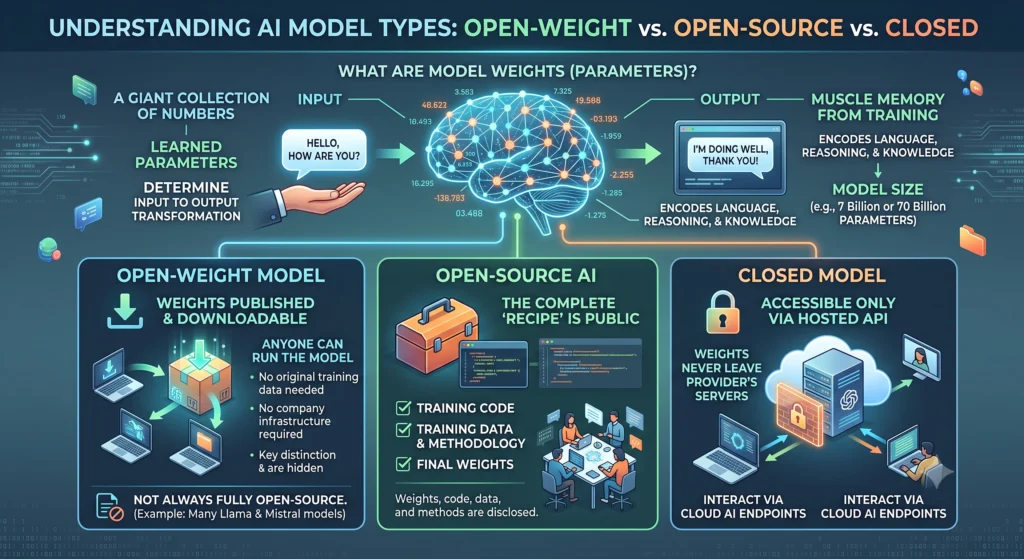
Poids des modèles : modèles ouverts, logiciels libres et logiciels propriétaires
A modèle de langage étendu (LLM) est, à la base, un immense ensemble de nombres appelés poids du modèle Les poids sont les paramètres appris qui déterminent comment le modèle transforme une entrée (comme une phrase) en une sortie (comme une réponse). On peut les comparer à la “ mémoire musculaire ” que le modèle développe pendant l’entraînement : des millions d’ajustements infimes qui encodent des schémas de langage, de raisonnement et de connaissances. Lorsqu’on parle de la taille d’un modèle — “ 7 milliards de paramètres ” ou “ 70 milliards de paramètres ” —, on fait référence au nombre de ces poids.
Un Modèle d'IA à poids ouvert Il s'agit d'une approche où les poids entraînés sont publiés et téléchargeables, permettant ainsi à quiconque d'exécuter le modèle sans avoir besoin des données d'entraînement originales ni de l'infrastructure de l'entreprise. Cela diffère de IA open-source, Ce qui implique techniquement que le code d'entraînement, les données d'entraînement et la méthodologie sont également publics, et pas seulement les poids finaux. De nombreux modèles “ ouverts ” bien connus — dont plusieurs de la famille Llama de Meta et Mistral — sont à poids ouverts plutôt qu'entièrement open source, car les ensembles de données d'entraînement ne sont pas divulgués même si les poids sont téléchargeables gratuitement. modèle fermé, en revanche, n'est accessible que via une API hébergée ; les poids ne quittent jamais les serveurs du fournisseur et les utilisateurs ne peuvent interagir avec le modèle que par le biais de points de terminaison de modèles d'IA basés sur le cloud.
Pourquoi la catégorie “ poids libre ” est importante
Les modèles d'IA à poids ouvert sont importants car ils transfèrent le contrôle du fournisseur du modèle à l'utilisateur. Au lieu de faire confiance à un fournisseur pour exécuter les inférences correctement, en toute sécurité et indéfiniment, une organisation peut héberger elle-même le modèle, examiner son comportement et le modifier. Cette distinction est à la base de l'ensemble du mouvement des modèles d'IA locaux et de l'IA auto-hébergée, et elle influence directement les décisions relatives à la confidentialité des données, à la personnalisation et aux coûts à long terme.
Fonctionnement des modèles à poids ouvert (Aperçu technique)
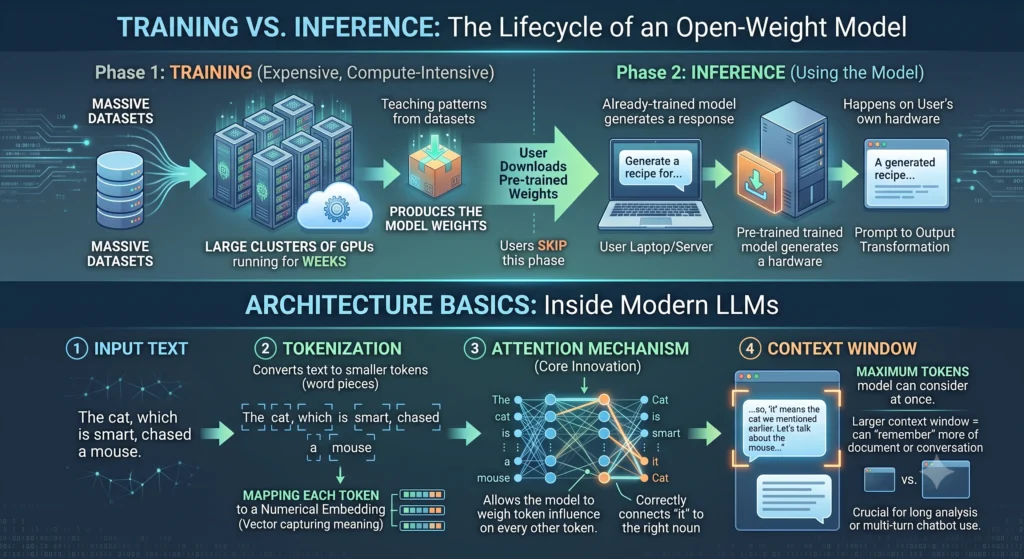
Entraînement vs inférence
La vie d'un mannequin comporte deux phases très différentes. Entraînement Il s'agit du processus coûteux et gourmand en ressources de calcul qui consiste à enseigner à un modèle des modèles à partir d'ensembles de données massifs — c'est ce qui produit les poids en premier lieu, et cela nécessite généralement de grands clusters de GPU fonctionnant pendant des semaines. Inférence Il s'agit simplement d'utiliser le modèle déjà entraîné pour générer une réponse à une nouvelle entrée ; cette étape se produit systématiquement lorsqu'un utilisateur exécute une requête sur un modèle à poids ouverts, sur son ordinateur ou son serveur. Les modèles à poids ouverts permettent aux utilisateurs de s'affranchir complètement de la phase d'entraînement : ils téléchargent des poids déjà entraînés par un tiers et passent directement à l'inférence.
Principes de base de l'architecture : transformateurs, tokenisation, attention, fenêtre de contexte
Presque tous les LLM modernes, à poids ouvert ou fermé, sont construits sur le principe suivant : architecture de transformateur, Le transformeur est une architecture de réseau neuronal introduite en 2017 qui traite des séquences de texte entières en parallèle plutôt que mot par mot. Avant de pouvoir traiter du texte, un transformeur doit le convertir par un processus spécifique. tokenisation — en décomposant les phrases en plus petits fragments appelés tokens (souvent des morceaux de mots) et en associant chaque token à un nombre intégration, un vecteur qui capture sa signification par rapport aux autres jetons.
L'innovation fondamentale qui rend les transformateurs efficaces est la mécanisme d'attention, ce qui permet au modèle de pondérer l'influence de chaque jeton de l'entrée sur sa compréhension de tous les autres jetons. C'est ce qui permet à un modèle de relier correctement “ il ” au nom approprié plusieurs phrases plus tôt. fenêtre contextuelle Il s'agit du nombre maximal de jetons qu'un modèle peut considérer simultanément — une fenêtre de contexte plus large signifie que le modèle peut “ se souvenir ” d'une plus grande partie d'un document ou d'une conversation à la fois, ce qui est important pour l'analyse de longs documents ou l'utilisation d'un chatbot à plusieurs tours.
Modèles de déploiement : local, périphérie, sur site, cloud auto-hébergé
Les modèles à poids ouvert peuvent être déployés de plusieurs manières selon le cas d'utilisation. Modèles d'IA locaux S'exécute directement sur un appareil personnel (ordinateur portable ou station de travail), ce qui est idéal pour les développeurs indépendants et les amateurs soucieux de leur vie privée. IA de périphérie Elle déporte l'inférence sur des appareils plus petits, plus proches du lieu de génération des données, comme un capteur d'usine ou une borne interactive, ce qui est utile lorsque la latence ou la connectivité constituent une contrainte. IA sur site Les déploiements exécutent les modèles sur des serveurs situés dans le centre de données propre à l'organisation, une pratique courante dans les secteurs réglementés. cloud auto-hébergé Les déploiements utilisent le même modèle à pondération ouverte sur des instances GPU cloud louées (AWS, GCP, Azure ou clouds GPU spécialisés) — l'organisation contrôle toujours la pile logicielle et les pondérations, mais évite de posséder du matériel physique.
Cas d'utilisation courants des modèles à poids ouvert
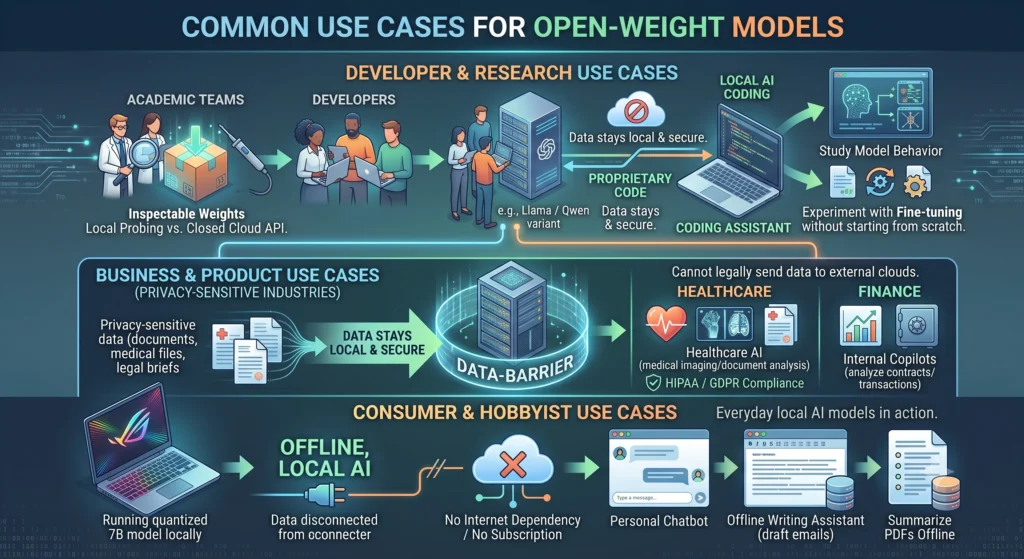
Cas d'utilisation pour les développeurs et la recherche
Les chercheurs et les développeurs utilisent des modèles à poids ouverts pour étudier le comportement des modèles, expérimenter des techniques d'ajustement fin et créer de nouveaux modèles spécifiques à un domaine sans repartir de zéro. Grâce à l'inspection des poids, les équipes de recherche peuvent analyser la manière dont un modèle représente les concepts en interne, ce qui est impossible avec les modèles d'IA propriétaires, accessibles uniquement par API et basés sur le cloud. Un assistant de programmation IA, construit sur un modèle à poids ouverts comme une variante de Llama ou Qwen et exécuté sur un serveur d'inférence local, est une configuration courante pour les développeurs, garantissant que le code propriétaire reste confiné à la machine.
Cas d'utilisation commerciale et produit, y compris dans les secteurs sensibles à la protection de la vie privée
Les entreprises des secteurs soumis à des exigences de conformité strictes — santé, finance, droit et administration publique — ont souvent besoin de capacités d'IA générative, mais ne peuvent légalement pas transférer leurs données vers des fournisseurs de cloud externes. Les équipes d'IA du secteur de la santé, travaillant par exemple sur l'imagerie médicale ou l'analyse de documents cliniques, optent fréquemment pour des modèles ouverts et auto-hébergés afin que les données des patients ne transitent jamais par une infrastructure tierce, garantissant ainsi la conformité avec des réglementations telles que la loi HIPAA ou le RGPD. De même, les institutions financières déploient des copilotes d'IA internes sur des modèles ouverts pour analyser les contrats ou les données transactionnelles sans exposer ces données à l'extérieur.
Cas d'utilisation des consommateurs et des amateurs
Les amateurs et les consommateurs soucieux de leur vie privée utilisent des modèles à poids ouvert pour des chatbots personnels, des assistants de rédaction hors ligne ou des projets de domotique, souvent via de simples outils de bureau. L'utilisation d'un modèle quantifié de 7 milliards de paramètres sur un ordinateur portable de jeu pour rédiger des courriels ou résumer des PDF hors ligne est un exemple désormais courant de modèles d'IA locaux en action, ne nécessitant ni abonnement ni connexion internet.
Comment exécuter et utiliser des modèles à poids ouvert
Prérequis matériels et environnementaux
Le facteur le plus important pour bien faire fonctionner un modèle à poids libre est VRAM — la mémoire dédiée de la carte graphique qui stocke les poids du modèle pendant l'inférence. Les modèles plus volumineux nécessitent davantage de VRAM : un modèle à 7 milliards de paramètres peut nécessiter environ 8 à 16 Go de VRAM en précision réduite, tandis qu'un modèle à 70 milliards de paramètres peut en nécessiter 40 Go, voire plus, sauf en cas de forte compression. Inférence GPU vs CPU Il s'agit d'un compromis essentiel : les GPU gèrent les calculs parallèles des transformateurs beaucoup plus rapidement que les CPU, l'inférence GPU est donc fortement préférée pour tout ce qui dépasse les petits modèles, bien que l'inférence uniquement CPU soit possible pour les petits modèles quantifiés à des vitesses plus lentes.
Quantification La quantification est une technique qui consiste à compresser les poids d'un modèle, initialement exprimés en nombres de haute précision (comme les nombres à virgule flottante 16 bits), vers des formats de plus faible précision (comme les entiers 4 ou 8 bits). Cette technique permet de réduire considérablement la mémoire requise et d'accélérer l'inférence, moyennant une légère perte de précision. Grâce à la quantification, il est possible d'exécuter sur du matériel grand public des modèles qui nécessiteraient autrement des GPU professionnels onéreux.
Obtention des pondérations des modèles et compréhension des licences
Les poids des modèles sont généralement téléchargés depuis des plateformes comme Hugging Face, où chaque page de modèle répertorie ses licence — un détail crucial qui détermine si usage commercial est autorisé. Certains modèles open-weight bénéficient de licences permissives (Apache 2.0, de type MIT) autorisant une large utilisation commerciale, tandis que d'autres sont distribués sous certaines conditions. licences réservées à la recherche ou des licences avec des plafonds d'utilisation (par exemple, des restrictions liées au nombre d'utilisateurs actifs mensuels d'une entreprise). Il est essentiel de lire attentivement la licence avant le déploiement, car les restrictions de licence peuvent entraîner de réels risques juridiques si elles sont ignorées.
Exécution locale des modèles : chaînes d’outils, environnements d’exécution, interface de ligne de commande/interface utilisateur/API
Plusieurs chaînes d'outils éprouvées ont considérablement simplifié l'exécution de modèles à pondération ouverte ces dernières années. Des outils comme Ollama et llama.cpp offrent des interfaces en ligne de commande simples et légères pour télécharger et exécuter des modèles quantifiés sur un ordinateur portable, tandis que des serveurs d'inférence comme vLLM ou Text Generation Inference sont conçus pour un débit élevé et une utilisation en production sur du matériel GPU dédié. La plupart de ces outils exposent une API locale qui imite les formats d'API cloud courants, ce qui permet de remplacer facilement un appel à un modèle d'IA cloud par un appel local dans le code applicatif existant, avec des modifications minimales.
Exposer sa propre API et l'intégrer aux applications
Une fois qu'un modèle est en cours d'exécution dans un serveur d'inférence, Elle peut être encapsulée derrière une API REST et intégrée aux outils internes, chatbots ou produits, à l'instar de tout modèle d'IA basé sur le cloud, mais hébergée intégralement au sein de l'infrastructure de l'organisation. Ce modèle est couramment utilisé pour les chatbots de bases de connaissances internes et les assistants de programmation IA, où l'API est protégée par le pare-feu de l'entreprise et accessible uniquement aux services internes authentifiés.
Réglage fin et personnalisation : invites, LoRA, optimisation du domaine
La forme la plus simple de personnalisation consiste à fournir des instructions et des exemples, soigneusement intégrés aux données d'entrée, afin de guider le comportement du modèle sans modifier ses pondérations. Pour une personnalisation plus poussée, LoRA L'adaptation de faible rang (Low-Rank Adaptation) est une technique d'ajustement simple courante qui consiste à entraîner un petit ensemble de paramètres supplémentaires par-dessus le modèle de base figé, permettant ainsi d'obtenir un comportement spécifique au domaine (comme un vocabulaire dédié au secteur de la santé) sans avoir à réentraîner l'intégralité du modèle. L'ajustement complet au domaine, qui implique de réentraîner des portions beaucoup plus importantes du modèle sur des données spécialisées, est plus gourmand en ressources, mais peut s'avérer judicieux pour les organisations développant un modèle véritablement spécifique à un domaine pour une tâche précise et à forte valeur ajoutée.
Avantages des modèles à poids ouvert par rapport à l'IA basée sur le cloud
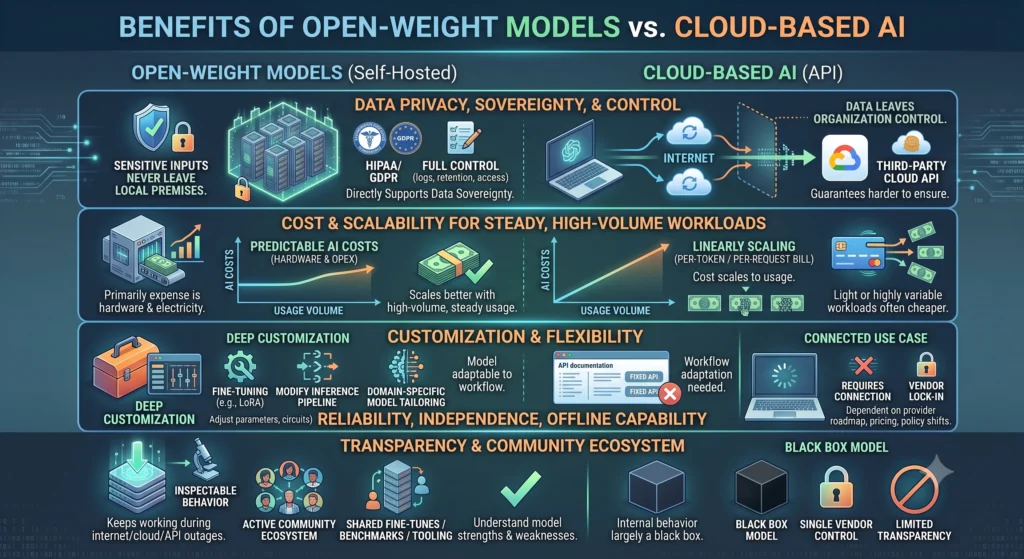
Confidentialité des données, souveraineté et contrôle
L'avantage le plus souvent cité des modèles d'IA à poids ouvert est la confidentialité des données : comme l'inférence s'effectue sur une infrastructure contrôlée par l'organisation, les données sensibles ne quittent jamais les locaux. Cela soutient directement souveraineté des données elle répond aux exigences des secteurs réglementés et offre aux organisations un contrôle total sur la conservation, la journalisation et l'accès aux données – un contrôle beaucoup plus difficile à garantir lorsqu'on s'appuie sur une API cloud tierce.
Coût et évolutivité pour des charges de travail stables et à volume élevé
Les modèles d'IA basés sur le cloud facturent par jeton ou par requête, ce qui peut devenir coûteux à grande échelle. charges de travail d'IA à volume élevé Avec une utilisation prévisible et stable, l'auto-hébergement d'un modèle à poids ouvert peut générer davantage de résultats. coûts prévisibles de l'IA Au fil du temps, les dépenses principales deviennent liées au matériel et à l'électricité plutôt qu'à une facture par requête augmentant linéairement. Ce calcul dépend fortement du volume d'utilisation : les charges de travail légères ou très variables restent souvent moins coûteuses sur les API cloud.
Personnalisation et flexibilité
Les poids ouverts permettent une personnalisation poussée — du réglage fin avec LoRa à la modification du pipeline d'inférence du modèle lui-même — ce que les API cloud fermées ne permettent tout simplement pas. Les équipes peuvent ainsi adapter un modèle spécifique à leur domaine précisément à leurs données et à leurs flux de travail, au lieu d'adapter ces derniers à une API fixe.
Fiabilité, indépendance, capacité hors ligne
Comme le modèle s'exécute localement, il continue de fonctionner en cas de panne d'Internet, d'incidents chez les fournisseurs de cloud ou de dépréciation d'API, et il évite les interruptions de service. dépendance vis-à-vis du fournisseur L'indépendance vis-à-vis de la feuille de route, des modifications tarifaires ou des changements de politique d'un fournisseur unique constitue un atout majeur pour les applications d'IA en périphérie et pour tout cas d'usage exigeant une capacité hors ligne.
Transparence et écosystème communautaire
Les modèles à pondération ouverte bénéficient d'écosystèmes communautaires actifs — partage de réglages, de points de référence et d'outils — qui facilitent la compréhension des forces, des faiblesses et des modes de défaillance d'un modèle par rapport à un système fermé dont le comportement interne est en grande partie une boîte noire.
Compromis et limitations par rapport aux modèles basés sur le cloud
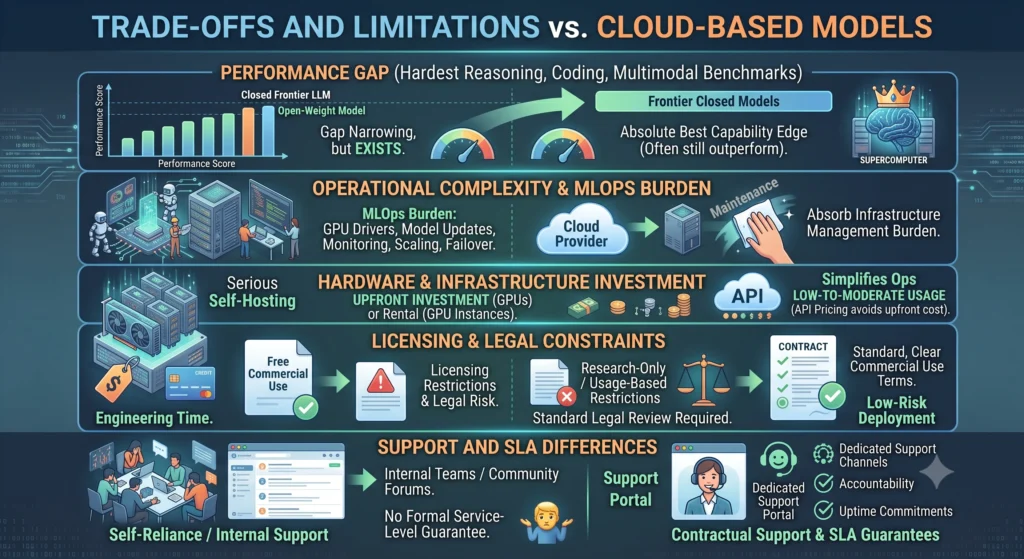
Écart de performance par rapport aux modèles fermés de frontière
Les modèles de pointe les plus performants (généralement des systèmes fermés hébergés exclusivement dans le cloud) surpassent souvent encore les meilleurs modèles ouverts sur les tests de raisonnement, de programmation et multimodaux les plus exigeants, même si l'écart s'est considérablement réduit ces dernières années. Pour les tâches nécessitant les meilleures capacités disponibles, les modèles d'IA basés sur le cloud peuvent encore conserver un avantage.
Complexité opérationnelle et charge MLOps
L'utilisation de modèles à poids libre introduit une véritable complexité opérationnelle: quelqu'un doit gérer les pilotes de GPU, les mises à jour des modèles, la surveillance, la mise à l'échelle et le basculement — la discipline généralement connue sous le nom de MLOps, ou les pratiques opérationnelles liées au déploiement et à la maintenance des systèmes d'apprentissage automatique en production. Les fournisseurs de cloud prennent en charge tout cela. gestion des infrastructures La charge que représentent leurs modèles hébergés est une des principales raisons pour lesquelles de nombreuses équipes optent pour des modèles d'IA basés sur le cloud malgré les compromis en matière de confidentialité.
Investissement dans le matériel et les infrastructures
L'auto-hébergement sérieux nécessite un investissement initial dans des GPU ou la location continue d'instances cloud GPU, ainsi que le temps d'ingénierie nécessaire pour les configurer et les maintenir — un véritable coût d'investissement ou d'exploitation que la tarification des API cloud évite totalement pour une utilisation faible à modérée.
Licences et contraintes légales
Tous les modèles à poids ouvert ne sont pas libres d'utilisation commerciale ; certains sont soumis à des licences réservées à la recherche ou à des restrictions commerciales liées à l'utilisation, et une mauvaise interprétation de ces conditions peut engendrer des risques juridiques. L'examen juridique des restrictions de licence devrait être une étape systématique avant tout déploiement commercial d'un modèle à poids ouvert.
Différences en matière de support et de SLA
Les fournisseurs de cloud proposent généralement des contrats assistance et SLA Les garanties — engagement de disponibilité, canaux d'assistance dédiés et responsabilité en cas de problème — sont essentielles. Les déploiements open-weight auto-hébergés s'appuient sur les équipes internes ou les forums communautaires pour le dépannage, sans garantie formelle de niveau de service.
Quand choisir un modèle open-weight plutôt qu'un modèle basé sur le cloud ?
| Facteur | Favorise l'IA à poids ouvert / locale | Privilégie l'IA basée sur le cloud |
|---|---|---|
| sensibilité des données | Haut niveau (santé, finance, juridique) | Faible à modéré |
| Volume d'utilisation | Volume élevé et constant | Léger ou imprévisible |
| Besoin de capacités de pointe | Adapté aux modèles ouverts robustes | Exige des performances absolument optimales |
| Expertise interne en MLOps | Disponible | Limité ou aucun |
| Exigence hors ligne/en périphérie | Requis | Non requis |
| Temps de déploiement | Peut accepter une configuration plus longue | Il faut lancer rapidement. |
Approches hybrides
De nombreuses organisations matures adoptent architectures d'IA hybrides, Le routage du trafic sensible ou à volume élevé vers un modèle auto-hébergé à pondération ouverte, tandis que les requêtes complexes, à faible volume ou non sensibles sont envoyées à une API cloud pour une capacité maximale, permet aux équipes d'équilibrer les capacités. IA dans le cloud vs IA locale Il s'agit d'un compromis dynamique plutôt que d'un engagement total envers un camp, et c'est de plus en plus la recommandation par défaut lorsque choisir entre l'IA locale et l'IA dans le cloud Il ne s'agit pas d'une décision simple.
Exemples pratiques
Assistant de codage auto-hébergé
Une équipe logicielle exécutant un modèle de code quantifié à poids ouvert via un serveur d'inférence local sur un boîtier GPU interne peut fournir à chaque ingénieur un assistant de codage IA qui complète automatiquement et explique le code sans qu'aucun code source propriétaire ne quitte le réseau de l'entreprise, répondant ainsi directement aux préoccupations en matière de propriété intellectuelle qui se posent avec les assistants de codage basés sur le cloud.
Cas d'utilisation dans un secteur sensible à la confidentialité : santé
Une startup spécialisée dans l'IA appliquée à la santé, analysant l'imagerie médicale en parallèle des notes cliniques, peut déployer un modèle multimodal à pondération ouverte sur site, garantissant ainsi que les informations de santé protégées restent dans un environnement conforme à la loi HIPAA plutôt que de transiter par des API externes, tout en bénéficiant de capacités d'IA générative pour la rédaction de résumés de rapports de radiologie.
chatbot de base de connaissances interne
Une entreprise de taille moyenne peut optimiser un modèle à poids ouvert avec LoRA sur sa documentation interne et le déployer comme chatbot de base de connaissances derrière son pare-feu, offrant ainsi aux employés des réponses rapides et précises sur les politiques internes sans exposer de documents confidentiels à un fournisseur externe.
Premiers pas : Étapes concrètes
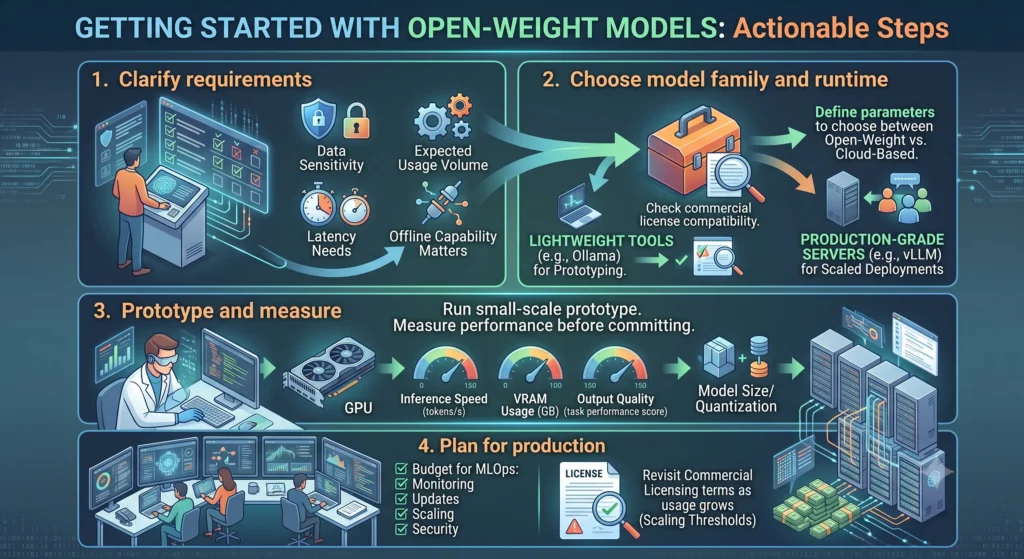
Clarifier les exigences
Commencez par définir la sensibilité des données, le volume d'utilisation prévu, les besoins en latence et l'importance de la capacité hors ligne ; ces réponses déterminent en grande partie si une IA ouverte ou basée sur le cloud est le meilleur point de départ.
Choisissez la famille de modèles et la durée d'exécution
Choisissez une famille de modèles open-weight dont la licence correspond à l'utilisation commerciale prévue, et associez-la à un environnement d'exécution adapté à la cible de déploiement : des outils légers comme Ollama pour le prototypage, des serveurs de qualité production comme vLLM pour les déploiements à grande échelle.
Prototype et mesure
Exécutez un prototype à petite échelle sur un matériel représentatif, en mesurant la vitesse d'inférence, l'utilisation de la VRAM et la qualité de la sortie par rapport à des tâches réelles avant de vous engager sur une taille de modèle ou un niveau de quantification spécifique.
Plan de production
Prévoir un budget pour les travaux MLOps en cours (surveillance, mises à jour, mise à l'échelle et sécurité) et revoir les conditions de licence à mesure que l'utilisation augmente, car les seuils commerciaux de certaines licences peuvent être déclenchés par l'échelle.
Conclusion
Les modèles d'IA open-weight offrent aux développeurs, aux fondateurs et aux équipes techniquement curieuses une véritable alternative à l'IA cloud : un contrôle réel des données, une personnalisation poussée grâce à un réglage fin et l'absence de dépendance vis-à-vis d'un fournisseur, en échange d'une prise en charge accrue de l'infrastructure et des opérations. Pour les cas d'usage sensibles à la confidentialité, à fort volume ou nécessitant une connexion hors ligne, ce compromis privilégie de plus en plus une approche locale. Grâce aux outils matures désormais disponibles, l'exécution d'un modèle open-weight performant n'a jamais été aussi accessible.